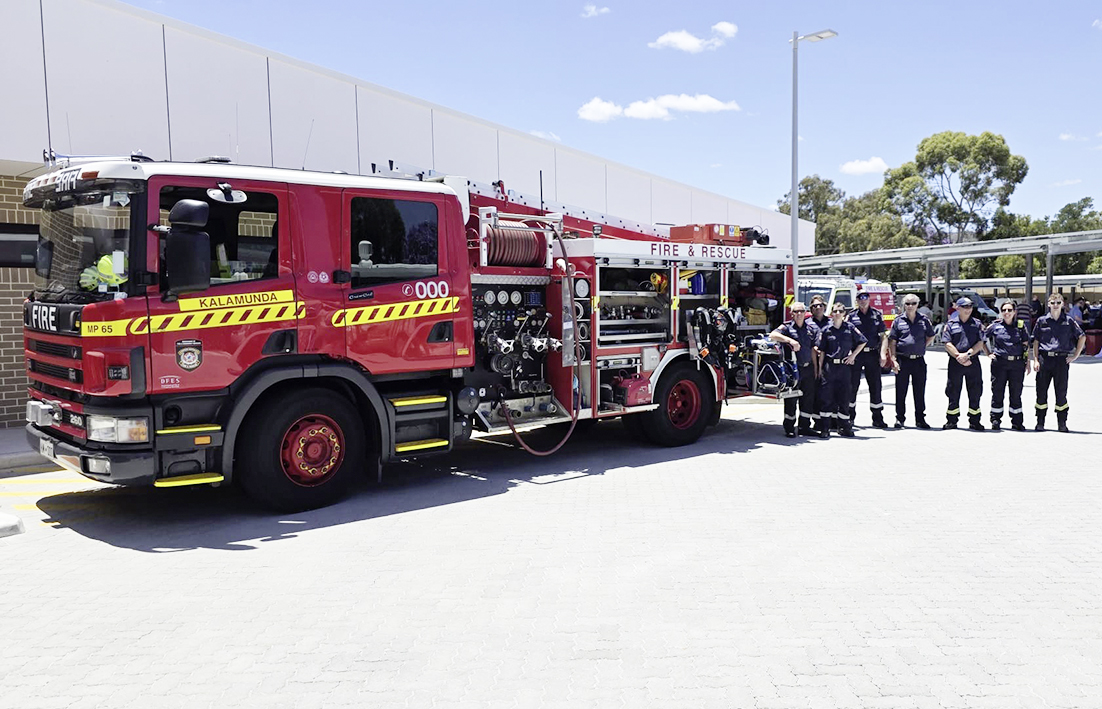
KALAMUNDA Volunteer Fire and Rescue Service (KVFRS) members say there is little confidence from the brigade in a Department of Fire and Emergency Services (DFES) move to switch to a type 2 vehicle due to a lack of consultation, collaboration and transparency.
KVFRS captain Tony Moiler and lieutenant Stuart Buckett said the choice to replace the brigade’s ageing type 1 appliance with a type 2 vehicle is incongruent with the area’s risks increasing significantly over the past 25 years.
“The result is the community ends up with an appliance that is less than what we had before,” Mr Moiler said.
“The type 2 is new (and) it won’t be used anywhere else in the metropolitan area and for some reason they’ve decided to deploy it in Kalamunda even though we are a first response brigade and have had the equivalent of a type 1 for the past 40 years.”
A DFES spokesperson said the agency will provide Kalamunda with a new Volvo urban pump type 2 appliance valued at approximately $950,000.
“(This) meets operational requirements and provides an enhanced capability,” they said.
“The new appliance type was designed with input from experienced volunteer and career firefighters to ensure it was fit for purpose, including the selection of the cab chassis.”
However, the brigade said the decision creates a situation where residents on one side of Kalamunda Road would receive a type 1 response from Midland or Welshpool stations, while their neighbours across the street would receive a type 2 response from Kalamunda.
“You’ve got neighbours who look across at each other from their front door, but one’s going to get one piece of life-saving fire appliance come in an emergency, and the other one’s going to get something that was built differently and a bit cheaper and less,” Mr Buckett said.
The brigade learned of the decision in December last year during a meeting about an unrelated matter.
“We were contacted sort of out of the blue and just told, ‘Hey, let’s catch up about something else,’ and then in that meeting we got told, ‘Oh yeah, elephant in the room, you guys need a new vehicle, we think it should be this’,” Mr Buckett said.
“And pretty much in that meeting we were told there was no chance of anything else.”
When the brigade requested further discussion, DFES presented data that “conveniently showed Covid (statistics),” demonstrating a dip in call numbers.
However, Mr Buckett said the brigade is more concerned with the severity and risk of fires rather than their frequency.
The brigade said there were significant increases in risk factors for firefighters in Kalamunda.
Commercial properties in their response area have more than doubled from 280 to 630 since their current vehicle was commissioned in 2001.
The area now included multiple high-rise buildings where previously there were none, and more than a dozen facilities requiring fire system boosting.
“We’ve now more than double the number of commercial properties, and commercial properties is probably one of the leading causes for the difference between a type 1 and type 2,” Mr Buckett said.
The DFES spokesperson said feedback from other VFRS brigades provided with urban pump type 2 appliances had been overwhelmingly positive and noted the new model could carry a crew of six, as opposed to five in the KVFRS’ current appliance.
“Given the large membership of Kalamunda VFRS, this will mean more volunteers can respond to incidents,” the spokesperson said.
“Additional response numbers will also enhance structural firefighting and breathing apparatus operations.”
However, Mr Buckett said additional crew capacity was not the issue, as neighbouring stations could provide extra personnel within minutes if needed.
“It’s not so much that we need more people at incidents, and if we do, within a few minutes, we’ll have two other trucks from our neighbouring station with another anywhere from five to seven or so, maybe even 10,” he said.
Cont. p6
From p3
The DFES spokesperson said Kalamunda VFRS had requested a 10-year-old appliance as a replacement vehicle, but the brigade said they suggested this option only after being told a type 1 was not available.
“It doesn’t have to be a new one,” Mr Buckett said.
“We said, ‘You know, we don’t mind if it’s seven years old because we know that they were looking at trying to rotate them’.”
Mr Moiler said a type 1 vehicle built specifically for Kalamunda two years ago has been sitting at the Forrestfield training academy and was never released to the brigade.
“All of a sudden, this vehicle that was built specifically for Kalamunda now suddenly isn’t available for our brigade,” he said.
The brigade said they were seriously concerned about maintaining consistent capability across the metropolitan area as risks increase and not the type 2 vehicle’s quality.
“From our understanding is this type 2 doesn’t actually do that,” Mr Buckett said.
“It doesn’t increase our capability and capacity to match the increasing and growing risk.”
The brigade said DFES has not brought a type 2 vehicle to Kalamunda to test whether it can handle the area’s steep driveways and hilly terrain.
“It’s inconceivable that they haven’t even brought one up the hill to even see how it even runs or drives and pulls up some of the roads and hills in Kalamunda,” Mr Moiler said.
The Kalamunda brigade serves a gazetted fire district covering approximately 24,000 residents.
Mr Moiler said he definitely did not want the issue to become a debate about the actual vehicles themselves, but the process with which the decision was handled that sends out the message that lack of transparency and collaboration was acceptable.
“We just can’t see the justification for the community of saying that all of a sudden it can be down spec’d while the risks have increased,” he said.
“It just doesn’t make sense.”
A petition against the change from type 1 to type 2 can be accessed here.