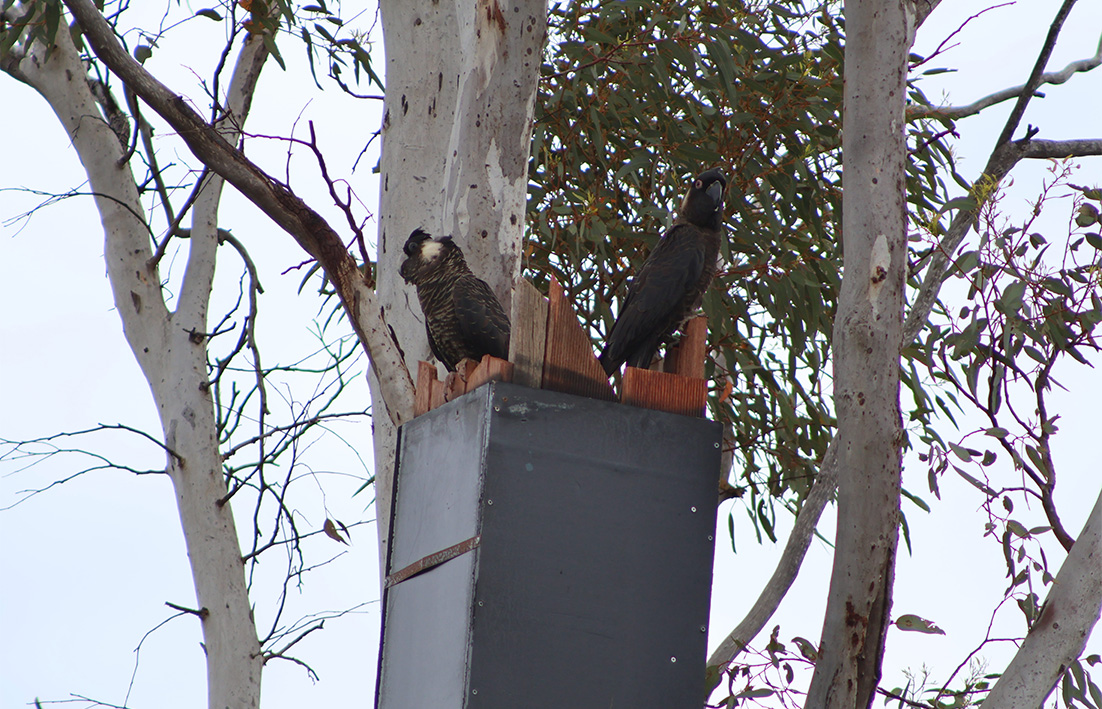
PRIVATE landholders across the Perth Hills are playing a vital role in the conservation of one of Western Australia's most threatened and iconic species, the Carnaby’s black-cockatoo.
Through Perth NRM's (natural resources management) ‘Building resilient landscapes in the Swan Region: Carnaby’s black-cockatoos project’, landholders across the Gidgegannup area have partnered with conservation experts to host artificial nesting hollows designed to support breeding populations of the endangered bird.
This partnership has recently seen 15 new artificial nestboxes installed on private properties ahead of the upcoming breeding season, helping to address a critical shortage of natural nesting hollows following years of bushfires, storms and habitat loss.
Perth NRM environmental program coordinator Emma Malloch said private landholders are becoming increasingly important partners in protecting breeding habitat for Carnaby’s black-cockatoos.
“Many of the remaining breeding areas for Carnaby’s black-cockatoos occur on or adjacent to private land,” she said.
“Without the support of landholders who are willing to host nestboxes, protect remnant vegetation and participate in conservation activities, it would be much harder to secure the future of this species.”
The nestboxes have been installed in partnership with renowned hollow specialist Dr Simon Cherriman from Re-Cyc-Ology and form part of a broader conservation strategy aimed at restoring breeding opportunities across the Swan Region.
The project is already demonstrating encouraging results.
Earlier nestbox installations completed just prior to the 2025 breeding season achieved almost immediate success, with one pair of Carnaby’s black-cockatoos observed inspecting a newly installed nestbox while installation works were still underway.
The pair successfully raised a chick, which later fledged from the site.
In Bindoon, a separate collaboration with volunteer group Carnaby’s Crusaders resulted in three successful fledglings emerging from 12 newly installed nestboxes during their first breeding season.
These early outcomes highlight the importance of providing additional nesting opportunities as natural tree hollows continue to decline across the landscape.
“Artificial nestboxes are not a replacement for mature trees, but they provide an important short-term solution while we work to restore habitat for future generations of cockatoos,” Ms Malloch said.
“What’s particularly exciting is seeing how quickly the birds are adopting these structures and successfully raising young.”
To maximise conservation outcomes, Perth NRM and Dr Cherriman undertook detailed baseline surveys to identify priority breeding locations before installations commenced.
Many of the selected sites were located within the Gidgegannup area, where severe bushfires and extreme weather events have significantly reduced the number of mature hollow-bearing trees available for breeding.
Beyond nestbox installation, Perth NRM continues to work with local communities, schools, landholders and local governments to restore feeding habitat and reconnect important wildlife corridors across the Swan Region.
Upcoming revegetation works will see more than 2.75ha of habitat planted across multiple areas, while community workshops will equip residents with practical ways to support the threatend bird.