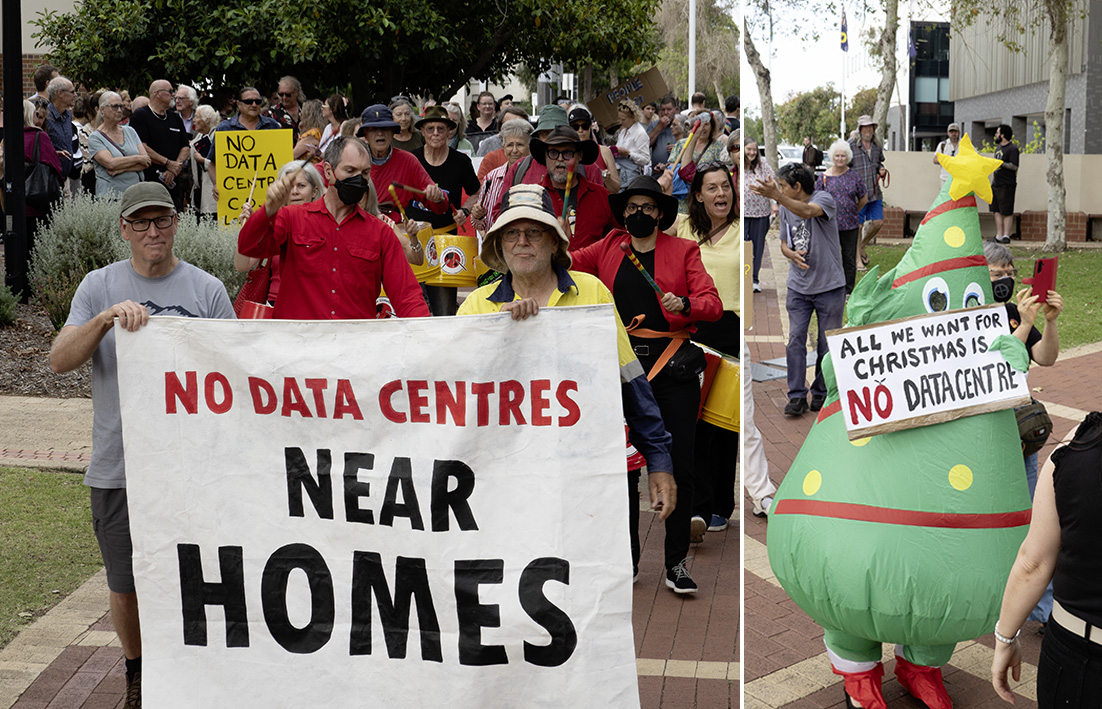
HAZELMERE residents have renewed calls for stronger scrutiny of CDC’s proposed Bushmead Road data centre, with speakers at a November 11 rally questioning its scale, electricity demands and proximity to homes.
Mary Street resident Jenni Moffatt said she had lived in the area for 35 years and accepted the presence of nearby light industry.
She said those businesses generally operated during daylight hours, with buildings of an acceptable height and noise that was intermittent.
“But it’s daylight hours. The buildings are of a height that we can all live with,” she said.
Ms Moffatt said her opposition centred on this proposal’s location and potential effects on neighbouring homes, rather than opposition to data centres generally.
“I’m not against them (data centres), I am against the fact that they’re putting them in suburbs,” she said.
“Surely, they’ve got enough money that they can go further out and build their own infrastructure.”
She said the proposed development would be less than 140m from her back fence and feared its height, noise, lighting and heat would change her neighbourhood’s character.
“It’s not just noise, the size, it’s also the loss of the animals that we all love here,” she said.
“We love our native animals and they’re a part of our area that brings us together, adding to the country feel and it’s why we came here and chose it as our home.”
At the rally, Trillion Trees communications coordinator Kate Herren urged council and staff to give community concerns greater weight during assessment.
“Today, hundreds of us came out to say no to this huge proposal for a hyper scale data centre in Hazelmere,” she said.
“We implore council and staff to listen well to community concerns and apply tighter oversight of planning.”
Ms Herren said more than 3100 submissions had been received against the proposal by the second week of November.
Mineral Policy Institute research associate Gwenaël Velge said the resource demands of large data centres warranted planning beyond individual applications.
“We need to have regional planning, if not national planning, because we know that this is happening over east as well,” he said.
“We ask that we don’t push these proposals through before we have a clear idea of how we’re going to go about it in the regional sense, not (just) the local level.”
Mr Velge said the scale of the facilities’ resource requirements were comparable to mining operations and that their impacts extended beyond neighbouring residents.
“We’re a research centre looking at how mining affects communities and we’re shifting our focus because we don’t consider these hyper scale data centres as warehouses,” he said.
“I don’t think people really understand the scale of them… this thing needs 192MW of electricity and I know that sounds quite abstract.
“Basically the entire south-west grid from Kalbarri to Kalgoorlie to down south is only 2.3GW (2300MW), so this will be about 10 per cent of the entire grid’s average demand for a single facility.
“We’re pushing this fast tracked and it’s a real problem.”
Former Kalamunda MLA Matthew Hughes said the state government’s handling of the proposal was inadequate and called for intervention.
“Why is the (state government) sitting on its hands letting CDC build… right on top of the residential community of Hazelmere?” he said.
“Why aren’t you calling these deficient rules into question and doing something about it?”
At the council meeting later that evening, Mr Hughes asked why council could not formally request the Planning Minister to call in the application.
City of Swan chief executive Stephen Cain said councillors could initiate a notice of motion under the city’s meeting procedures.
He also said residents could seek to address the assessment panel when the responsible authority report was presented.
The City of Swan says the Metro Outer Development Assessment Panel will determine the application, with the city preparing a recommendation and reporting community submissions.
On its project website, CDC says it selected an industrial site to minimise impacts on surrounding communities.
It says acoustic treatments would keep operational noise comparable with residential night-time background levels, it would fund electricity connection infrastructure, and its closed-loop cooling system would recirculate water.