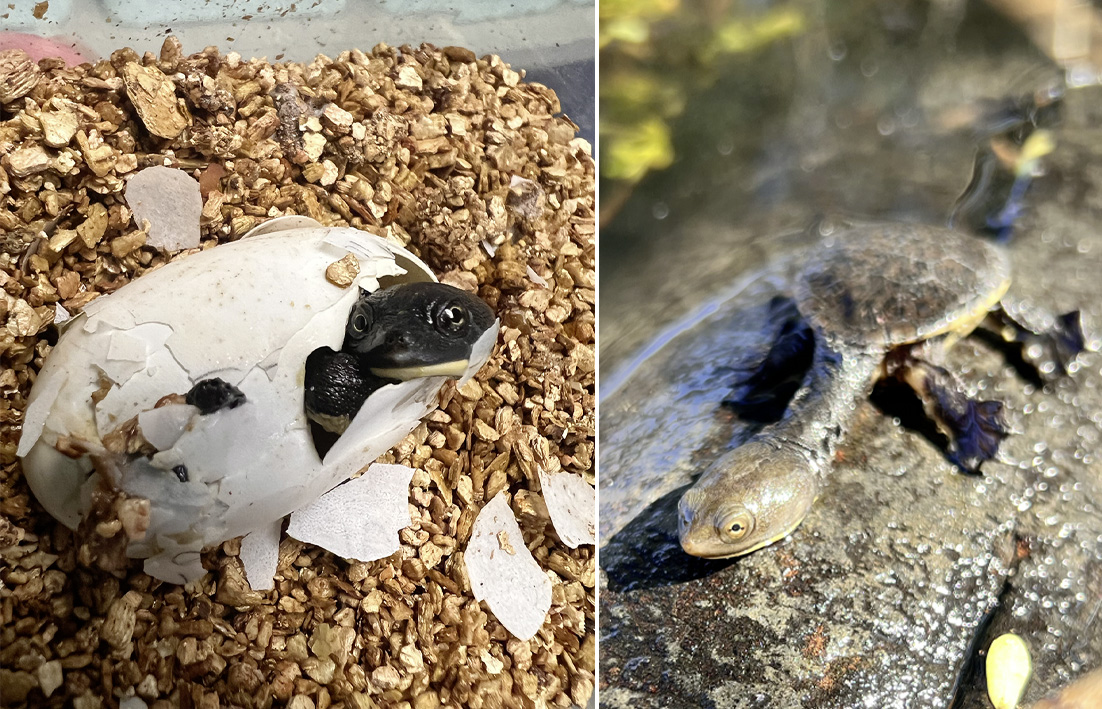
MURDOCH University researchers have found the first evidence that artificially incubated southwestern snake-necked turtles can survive in the wild for more than a year after release, offering hope for struggling populations in Perth’s urban wetlands.
During annual population surveys at Manning Lake in October 2026, PhD candidate April Sturm and Dr Anthony Santoro from the Centre for Sustainable Aquatic Ecosystems recaptured a juvenile southwestern snake-necked turtle that had been artificially incubated at Murdoch University and released into the wild the previous year.
The turtle weighed a mere 4.77 grams when it was released in July 2025 and had grown to 100 grams by the time it was recaptured.
The finding comes amid growing concerns for Perth’s urban turtle populations, where researchers have found a worrying lack of juvenile turtles to replace ageing adults.
“Catching juvenile turtles is rare in Perth wetlands, so every time we catch one at any of the four study sites where I have released hatchlings, I check it against my photos and this one was a match,” Ms Sturm said.
Until now, researchers had only been able to track hatchlings for a few weeks after release due to the limitations of existing tracking technology.
The recapture is the first confirmation that an artificially incubated hatchling survived long-term in the wild.
Dr Santoro said climate change and urbanisation were placing increasing pressure on the species through habitat loss, predation, road mortality and drying wetlands.
“The biggest warning sign we have found is that the turtle populations in many urban wetlands around Perth are missing juveniles,” he said.
“While we still see adults in these populations, without juveniles to replace them, the populations will eventually disappear. Ideally, we need to act now rather than wait until the populations are gone.
“This species of turtle only occurs in the southwest of Western Australia. If we lose it here, it’s gone forever,” Dr Santoro said.
“This is encouraging evidence that artificial incubation could help boost juvenile numbers in populations where they are largely missing,” she said.
The result also confirmed that photo-identification was a workable tool for tracking juveniles.
“We now have a way to recognise released hatchlings and confirm their survival if we capture them during future surveys,” Ms Sturm said.
“This is big news for us because it is really difficult to track hatchling turtles for more than a few weeks after release as they are too small for any of the current long term tracking technology.
Ms Sturm said the recapture was encouraging for turtle conservation.
“While artificial incubation should be a last resort, and used in conjunction with other conservation methods, this finding shows it can play an essential role in helping restore at-risk populations,” she said.
“Finding a healthy young turtle we released more than a year ago is a hopeful sign. It shows the conservation tools available to us can work”