No green future planned
Dear Echo News,
I read with dismay the Echo’s recent article on the City of Kalamunda’s new Future Forest Policy.
Despite the soothing name, this draft policy is not a plan for a greener future – it is a thinly veiled framework for tree destruction under the guise of balance.
Let’s be clear: this policy does not protect trees – it gives them a bureaucratic death sentence.
It introduces a range of exemptions so broad that nearly all residential land is effectively removed from meaningful oversight.
In fact, when questioned at a recent council meeting, the city’s own senior planner admitted the policy is “not primarily about protecting trees” but rather about “encouraging a balance” that permits either tree retention or removal – including payment in lieu of actual greenery.
That’s not balance; that’s capitulation.
Under this policy, developers can exploit these exemptions to remove large, mature trees – often after building approvals – without genuine scrutiny. Tree removal becomes an administrative formality, and the maximum penalty is an offset payment of just $10,000 per tree.
That’s the price tag the city has put on our natural assets. Once paid, the bulldozers roll in.
This is not just disappointing – it is directly at odds with the city’s own strategic community plan, which pledges to protect the natural environment and achieve 30 per cent urban tree canopy.
Yet this policy excludes exactly the types of land – private residential and redevelopment sites – where most canopy loss is occurring. How can such a contradiction be justified?
To compound the insult, the city is asking ratepayers to fund an additional full-time employee to help implement this deeply flawed policy – mere weeks after rates were increased.
Why should we pay more to see our trees destroyed more efficiently?
There was a better path.
The Western Australian Local Government Association (WALGA) developed a robust, enforceable model policy adopted by several other local governments including Victoria Park and Fremantle.
It puts protection before convenience.
Kalamunda, by contrast, has crafted a policy of evasion: promising “future forests” while clearing today’s trees.
Residents asked for a tree protection policy.
What we got instead was a death watch protocol.
Voters should remember this in October’s election.
Councillors who claim to value our natural environment must be held accountable for delivering a policy that does the opposite.
C Dornan
Wattle Grove
--------------------------------------------------------------------Speed limits don’t go far enough
Dear Echo News,
I see that the speed limit on Greenmount Hill has been reduced to 70km/hr, after a series of serious accidents; well done – but does it go far enough?
As the guy who led the campaign to get the speed limit reduced from 90km/hr to 70km/hr, on Great Eastern Highway from Bilgoman Road to Mundaring’s eastern limits back in the late 1990s (it was reduced from 90km/hr to 80km/hr, so only partially successful, and I thank then local MP, Judi Moylan and the community for their support) I now urge for the limit on that stretch to also be reduced to 70.
Traffic density and speed have increased in the almost 20 years since that campaign (especially heavy trucks) and anyone attempting to enter or leave Great Eastern Highway between Bilgoman Road and Mundaring takes their life into their hands, every time.
Those living in homes on the highway face that arduous task several times a day.
What’s really silly is that the recently reduced limit going up and down Greenmount Hill now encourages drivers to speed-up as they crest the hill, eastwards, as the limit increases to 80km/hr, when coming up the hill (against gravity) is safer than when you have crested the hill and start rolling along – aided by gravity, at the higher allowed speed. That makes no sense at all.
Let’s respect the safety of everyone and take that extra 10km/hr from the speeding trucks and peak hour users, who sometimes don’t make it to their destination without incident, for the sake of a minute saved.
P Carman
Hovea
--------------------------------------------------------------------Station parking concerns
Dear Echo News,
Regarding Midland train station parking.
I catch the train about once a week.
This has been made more difficult in the opening of the new parking station.
I have an ACROD parking permit and while there is adequate provision for parking at the new parking station, it is a long walk to the train.
At first there is a ramp to negotiate, then a walk of about 150 to 200 metres to reach the station entrance, and a further walk to the train.
This has always been the case, but it is now exacerbated by the long walk from the parking station.
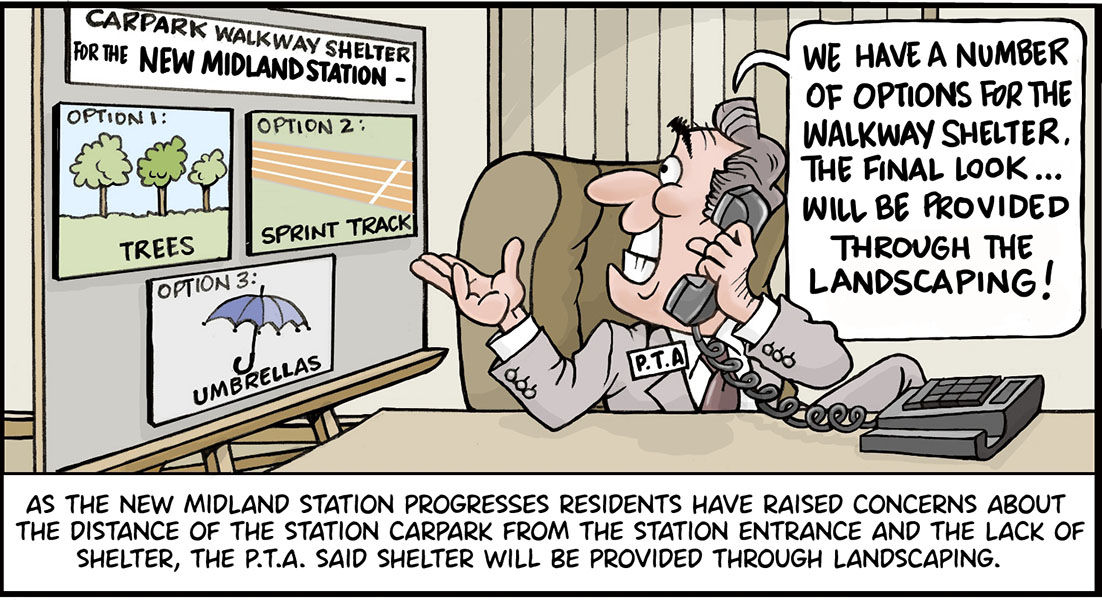
About half the walkway is uncovered, so slow moving people are going to get wet.
I am recovering from two hip replacements, so eventually I will not struggle to reach the train station entrance, but for others who are more disabled than I, it will be an extra burden to bear and that is not fair.
I have written to Transperth and was subsequently phoned by someone in the disability section.
He than visited Midland and agreed that the situation was not satisfactory.
However, he said it was unlikely anything would be done for at least 18 months.
I find this all very unsatisfactory where people who are already struggling have to overcome further obstacles because of poor planning.
It is unfair and discriminatory and something should be done.
G Eattell
Chidlow