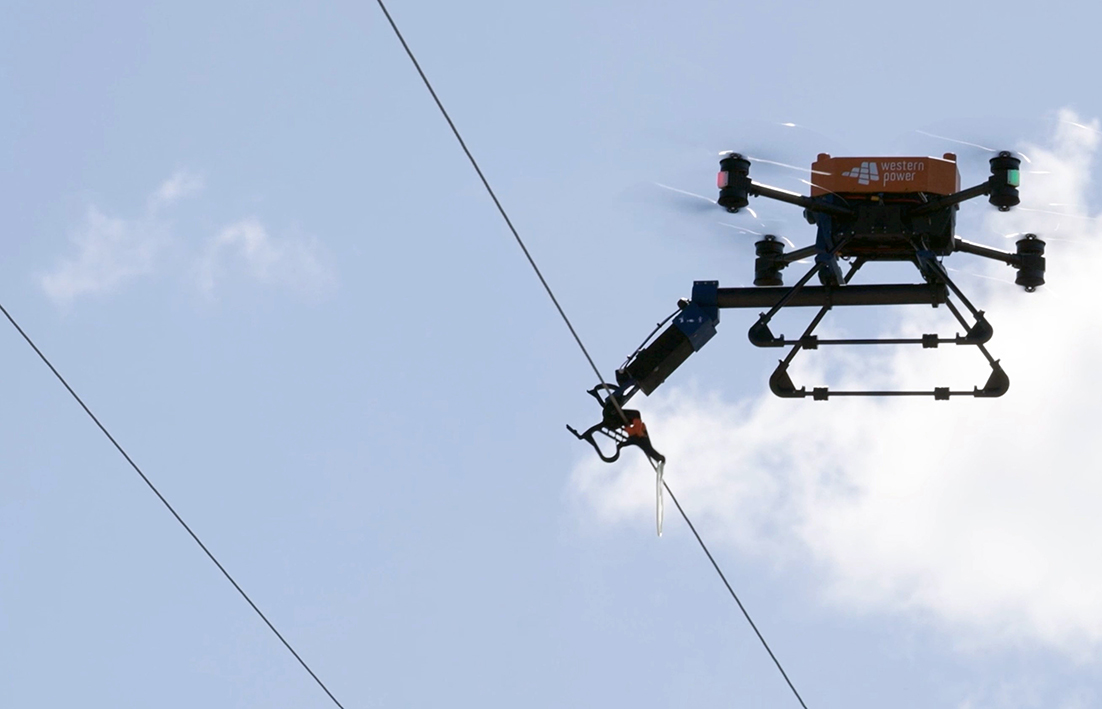
DRONE technology plays a critical role at Western Power, enhancing maintenance operations and increasing network resilience for the community.
Western Power’s Head of Operational Maintenance, Brett Hovingh, said the way Western Power uses drones in its operations continues to evolve, with new capabilities being implemented to bolster maintenance techniques.
“We’ve trained 63 employees as remote pilots and use 24 specialist aircraft supporting our operations across our vast network,” Mr Hovingh said.
“Our teams use drones to assist in a range of tasks including asset inspections, patrols, fault finding and reporting.
“The Western Power network is one of the world’s largest stand-alone grids spanning more than 255,000km from Kalbarri in the north, to Albany and Bremer Bay in the south, and out to Kalgoorlie in the east.
“Locating faults across such a large area can be time consuming and often involves travelling in challenging terrain but drones can perform the same task in a fraction of the time.
“To expand this capability, we’re finalising extended visual line-of-sight rules with the Civil Aviation Safety Authority (CASA) so we can fly drones over an extended range/area for faster fault finding, reducing the duration of outages for the community.”
We’re also trialling innovative new applications of drones like our 2025 line-stringing trial, proving a drone has the potential to be used to string replacement conductors which helps to reduce impact in environmentally and culturally sensitive areas.
“This trial showed that drones can be used to string line in hard-to-reach places - like over bodies of water - hauling line faster and safer than a raft crew,” Mr Hovingh said.
“Another trial involves using drones to attach locally built Rotamarkas, will help steer birds clear of powerlines and mark machinery clearances in farming paddocks for safety.”
Trials of other drone applications including mapping powerlines and substations using LiDAR to create precise 3D images and “drone-in-a-box" units to patrol substations for remote security are also ongoing.
“We’re exploring how we can use drones to improve the safety of our network and our operations such as remotely monitoring our sites and to checking assets after storms before our crews set foot on-site,” Mr Hovingh said.