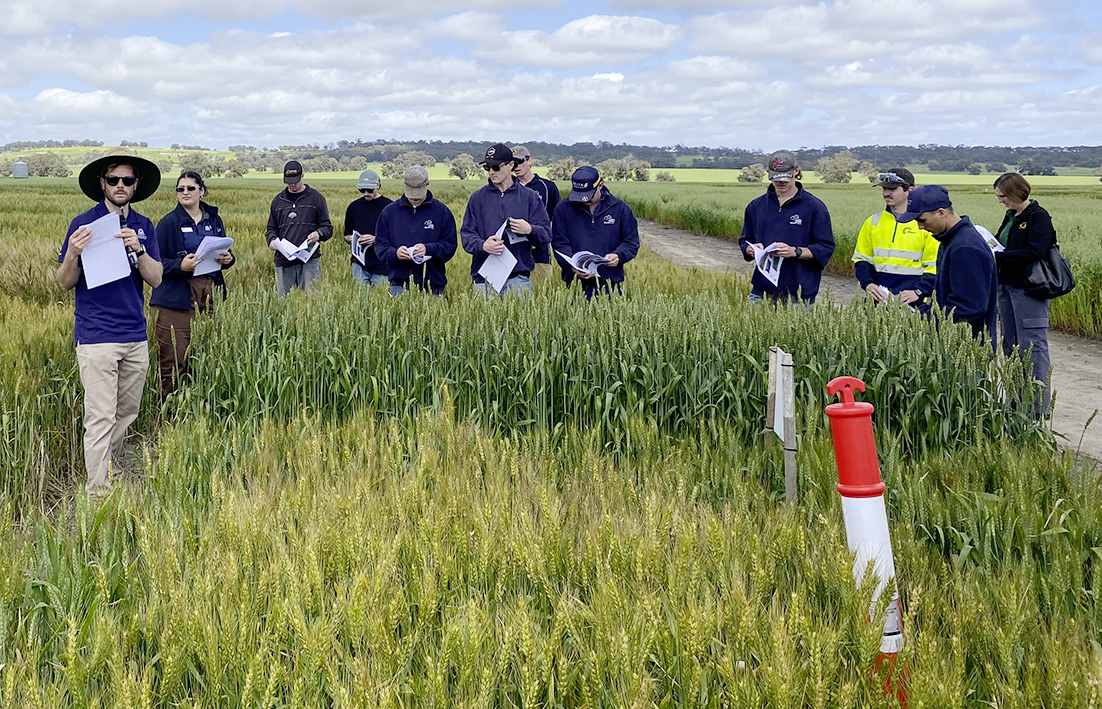
THE latest advances in frost research were revealed at the recent Department of Primary Industries and Regional Development’s (DPIRD’s) annual Dale Research Field Day.
About 40 visitors to the Dale Research Station, near Beverley, heard how DPIRD works on a range of fronts to help grain growers reduce the impact of frost events, backed by co-funding from the Grains Research and Development Corporation (GRDC).
Frost events can cost Australian grain growers hundreds of millions of dollars per annum in lost production and quality, in addition to a significant emotional toll.
While so far this year there have not been widespread frost events across the State, there were reports of isolated occurrences in the Avon Valley, Great Southern and Lakes district.
Research scientist Brenton Leske profiled research to validate anecdotal evidence that the structure and composition of a plant can influence its sensitivity to frost damage during flowering.
“Observations and research findings from past research have pointed to greater frost protection from physical features, such as heads, the lack of awns and some vascular anatomical features,” Dr Leske said.
“The results from this project will establish whether it is possible to manipulate such traits to help wheat breeders produce new varieties that will improve crop yields in frost-prone cropping environments.”
Another joint DPIRD-GRDC project builds on previous research that used controlled environment screening to show differences in frost sensitivity could be due to differences in plant tissue composition and how they respond to freezing injury.
“This research seeks to validate this finding under field conditions using a breeding population and a diversity panel of wheat lines,” Dr Leske said.
“The project aims to identify molecular markers for frost tolerance across a greater range of wheat lines.
“We will assess whether new profiling methodologies can be developed into a reliable selection tool for wheat breeders and pre-breeders to aid the development of new, more resilient wheat lines.”
The Dale site is one of three sites nationally, with the others at Mintaro, South Australia, and Wagga Wagga in New South Wales.
DPIRD research scientist Amanuel Bekuma told the gathering research to improve chickpea frost chilling is also progressing, which has identified up to 20 lines that consistently showed more than 80 per cent pod viability under chilling period.
Increasing the cold tolerance of chickpea could lead to improved productivity nationally and the expansion of chickpea cultivation in southern regions of Australia.
DPIRD research scientist Meredith Guthrie provided an overview of frost forecasting, frost maps and climate outlooks to help growers navigate the remainder of the season.
“Frost can still occur in October, with Wandering having on average five nights below 2C,” she said.
“Unlike rainfall, frost is difficult to forecast, however, growers are generally aware of where frost occurs on their farm and online tools are available to guide when best to inspect paddocks for damage.
“Growers can use DPIRD’s Extreme Weather Events tool, which indicates where frost events have occurred in WA, while the Bureau of Meteorology’s MetEye tool forecasts frost up to a week ahead.”
For more frost tools and support, identification guides, risk and frosted crop options visit the DPIRD website and search for ‘frost’.