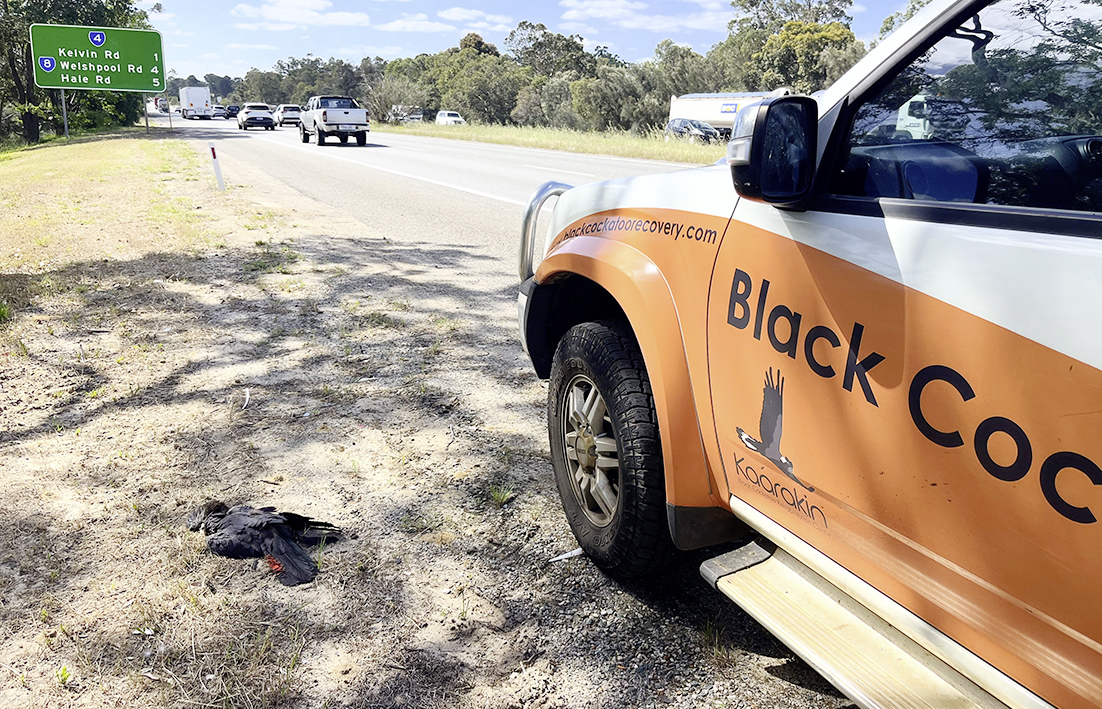
ALARMING figures of fatal black cockatoo strikes along local highways have led to a critical dialogue opening up between Main Roads WA and Kaarakin Conservation Centre.
The recent collaboration, announced by the conservation centre, comes as black cockatoo deaths from vehicle strikes have been climbing steadily in recent months.
Sam Clarke, an animal management officer at Kaarakin, describes the increase in animal fatalities as deeply concerning and an urgent problem.
“Every year we rescue more and more birds, and usually just over 50 per cent of those rescues have been hit by cars along our roads,” he said.
The frequent collisions have been specifically recorded along major throughfares, including Roe and Tonkin highways, where the problem along these high-traffic corridors is acutely felt.
The escalating frequency of fatal collisions is directly linked to the loss of natural habitat in the Perth Hills, forcing the threatened birds to forage in high-risk areas.
Mr Clarke warns that rampant urban development has pushed the residual foraging of vegetation dangerously close to these major throughfares.
“The problem now is that a lot of the vegetation that is left is near the side of the roads, which encourages them in close,” he said.
“They’re also attracted to the roads themselves to drink from puddles formed by wet weather or to feed on accidental grain spills, which are a serious hazard.”
The collaborative efforts between Main Roads and Kaarakin are now focusing on specific, proactive mitigation strategies, including the installation of dedicated warning signage and the tactical management of roadside vegetation near known feeding areas.
“We’re engaged with Main Roads at the moment to try and make them aware of these issues… to see if there are some solutions around pruning back foraging trees,” Mr Clarke said.
He noted that the trees and other native vegetation near these roads while vital to the ecosystem, are now posing a deadly threat.
“The problem is those trees are branching really low to the ground, so the cockatoos are feeding at traffic height,” he said.
“If we take the bottom three or four metres of branches, they can still forage there but just above traffic height.
“Even the median strip planting… they’ve had to end up removing or cutting the flowers off them every time they flower as to not draw the cockatoos onto the median strip of a 100km/h road.”
A Main Roads spokesperson has said that Main Roads WA continue to actively monitor black cockatoo’s foraging on local roads and have begun implementing strategies to mitigate these risks.
“Main Roads became aware that black cockatoos had been foraging along Tonkin Highway in Ellenbrook,” they said.
“The agency promptly removed the flowers that were attracting the birds from a section of median strip on Tonkin Highway... and have continued to monitor the situation.
“Main Roads donated the branches to the Kaarakin Black Cockatoo Conservation Centre to support their critical rehabilitation work.”
The welfare of black cockatoos in the area is such a concern that the City of Swan has recently opened up public consultation on a new black cockatoo conservation action plan which is expected to be presented to the council in mid 2026.
The north-east area of Perth is home to three threatened black cockatoo species: the endangered Carnaby’s cockatoo, the critically endangered Baudins cockatoo, and the vulnerable Forest red-tailed black cockatoo.
Conservationists have warned that if declining numbers are not turned around, all three could be extinct within 20 years.
Mr Clarke stressed that effective mitigation in the local area hinges on precise data.
“It all starts with reporting, because the first thing they do is ask: 'Can you tell us exactly where on that road this is a problem?”he said.
Mr Clarke urges the public to urgently report all deceased black cockatoos on roads to the Department of Biodiversity, Conservation and Attractions website. www.dbca.wa.gov.au/management/threatened-spe cies-and-communities/resources