THE City of Kalamunda faces three separate planning challenges in High Wycombe centred on Sultana Road West land-use conflicts, the delivery of a Metronet station, and more recent rezoning concerns at Hatch Court.
The city said it wanted to emphasise that while the challenges were all located in High Wycombe, they arose from different decisions made at different times and should not be treated as a single planning problem.
Echo News has a look back at the history of the area and how planning priority changes caused unforeseen consequences for High Wycombe residents living between residential and industrial zones.
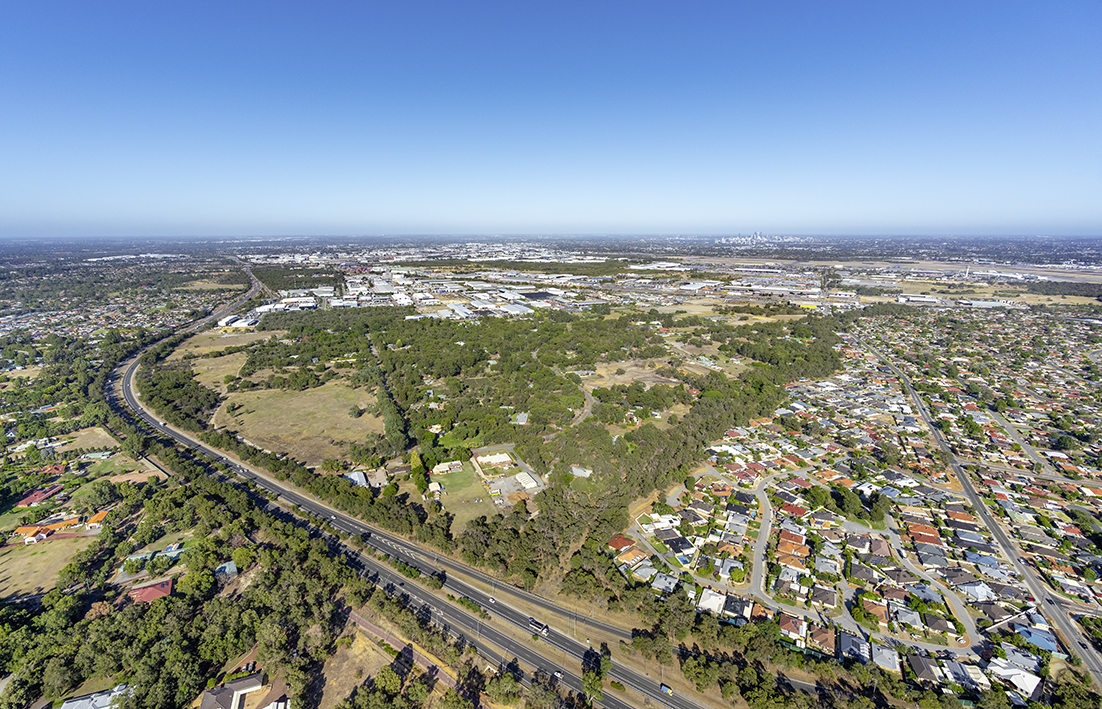
One of the longest-running issues is where industrial and residential zoning meet along Sultana Road West, which has been a source of reported negative quality-of-life impacts for residents for many years.
As reported in Sultana Road West residents’ buffer concerns remain, City of Kalamunda Mayor Margaret Thomas said the situation was the result of planning transitions over time rather than a single decision by the council.
The city said land in High Wycombe South, adjacent to Sultana Road West, was originally planned and zoned for industrial use under earlier state and local planning frameworks.
Before 2010, expectations around buffers and separation distances were guided by policies that predated current interface and environmental standards, with roads and lot boundaries often relied on for separation.
Between 2010 and 2014, planning for the Forrestfield–High Wycombe Industrial Area continued, and the city planned for additional industrial development in its local planning strategy.
Changes were introduced with its consequences on resident’s amenities becoming apparent later, when in the same period, the Western Australian Planning Commission (WAPC) progressed planning changes affecting High Wycombe South.
This was in response to major state infrastructure announcements related to the Forrestfield Airport Link.
In 2014, land north of Sultana Road West which was originally intended for light industrial use began transitioning toward higher-density residential outcomes, to fit state government infill and urban consolidation goals.
The city said these decisions were made within the state planning system, with local government acting primarily as a referral and implementation authority.
From 2014 to 2016, residential zoning progressed alongside existing industrial uses that had been lawfully approved under earlier planning frameworks.
Some of those industrial operations continue today, operating under approvals granted before detailed residential planning was finalised.
As residential development increased, concerns emerged about noise, light, odour and traffic impacts from nearby industrial activity.
By 2016, Sultana Road West was identified as the interface between industrial land and future residential areas, with planning controls applied at the subdivision stage.
Despite those controls, residents increasingly questioned whether buffer distances were adequate and where responsibility for mitigation sat.
The city said it responded to enquiries using information available at the time, while also noting that some decisions and records were held by state agencies.
Between 2020 and 2024, residents sought greater clarity about the planning history and redevelopment potential of the area, prompting broader discussions about infrastructure, land values and long-term outcomes.
In parallel, a second challenge emerged with state government plans for a Metronet station in High Wycombe.
To support transport-oriented development, land originally planned for industrial use was rezoned for residential purposes, increasing the proximity between homes and existing industrial operations.
The city said this rezoning, driven by state planning priorities, intensified the interface issues now experienced by residents.
In 2024 and 2025, concerns were formally raised at council meetings, prompting the chair of the WAPC to request a joint approach between the city and the state government.
A state-led working group was then established to address interface concerns along Sultana Road West.
The city has said it continues to advocate for state assistance, including infrastructure investment and planning changes, to improve outcomes for High Wycombe South.
The third issue, raised more recently, relates to rezoning concerns at Hatch Court, which the city has identified as a separate planning matter despite its location within High Wycombe.
The city said it is working with the Department of Planning, Lands and Heritage to clarify responsibilities and explore future options.
While acknowledging resident frustration, the city said any response must be lawful, evidence-based and consistent with the planning framework.
The city has described the situation as a legacy planning issue requiring long-term collaboration between local and state government rather than an immediate solution.
City of Kalamunda officers said the planning timeline would be made publicly available online to provide clarity for residents.