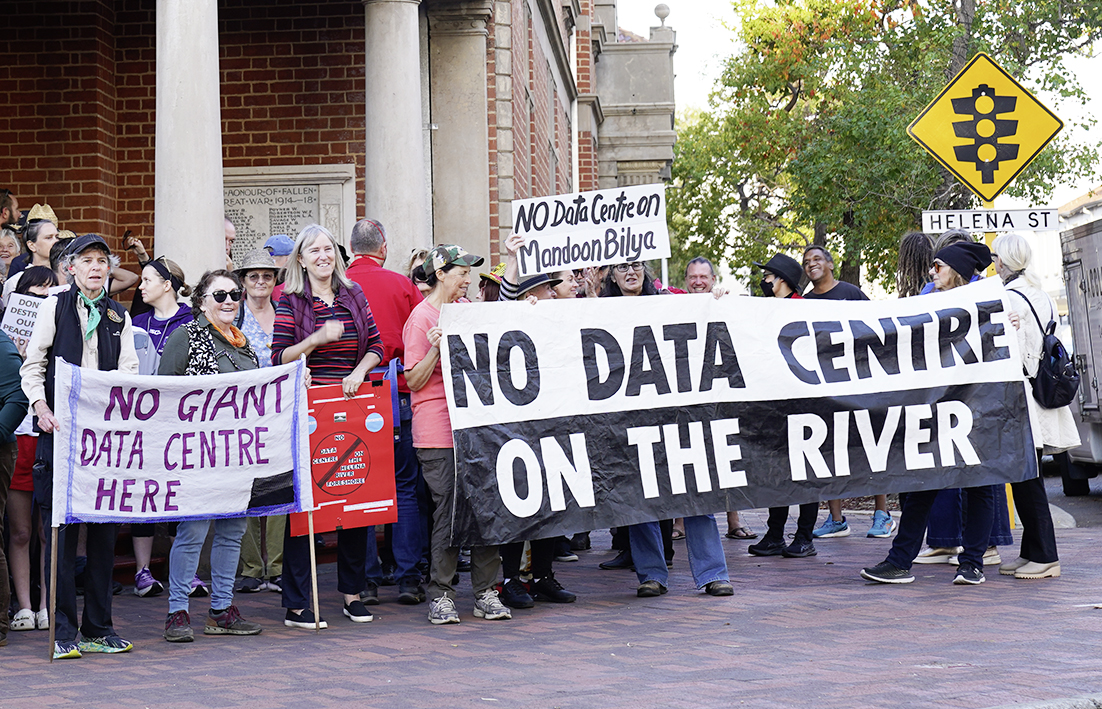
AFTER overwhelming community opposition, the much-criticised Hazelmere data centre application has been withdrawn by Sydney-based data centre company GreenSquareDC.
The withdrawal came after a City of Swan council review of the proposed development attracted almost 1900 public submissions.
At a May 13 council meeting before the withdrawal announcement councillors had voted 11-2 in favour of mayor Tania Richardson providing a deputation against the proposal at the JDAP meeting on May 19.
On Thursday, May 14 the council released its responsible authority report into the centre in which council staff recommended rejecting the proposal.
The data centre was to have been built alongside the Helena River and next door to the Helena River Waldorf School.
Over the past couple of months, residents have hit out at the continued insistence by GreenSquareDC that the proposal was suitably located, Proposed new data centre comes under fire, (Echo News, March 12).
They also criticised the City of Swan for allowing the application to proceed so far without the knowledge of the community.
Hasluck MP Tanya Lawrence said she was notified on May 14 by GreenSquareDC that the company had decided to formally withdraw the application.
“Local residents came to me with serious concerns about this proposal and as their representative I formally raised those concerns with the WA ministers for water, energy and the environment,” Ms Lawrence said.
“I engaged with the proponent to further discuss my community’s concerns, and I was advised that they had decided to withdraw the application.”
Bibbul Ngarma executive director Francesca Flynn said they were relieved the strength of the local community had come together to protect the river and each other.
“We are so relieved to be able to stop working so hard on this and get back to our number one priority of caring for the river,” Ms Flynn said.
“The Mandoon Bilya (Helena River) is central to our work through our BoorYul-Bah-Bilya (BBB) Program, a long-term river restoration program.
“BBB is developing a new model for community-led river catchment management to mark the 2029 Perth bicentenary.
“Our BBB Rangers are working with schools and community groups to restore the lower river as part of our vision to establish the Mandoon Bilya Riverpark as a key Bicentenary initiative.
“This proposal was so inappropriate that it’s difficult to identify a less suitable location.
“It is approximately 40m from the river channel, adjacent to a conservation wetland, located on two Aboriginal heritage sites, next to a primary school and in close proximity to private residences.
“We hope that in the future, data centre providers will engage genuinely and openly with the community and seek their input and involvement in decisions that impact them, including identification of the most appropriate sites for their facilities.”
City of Swan councillor Sarah Howlett said while she was pleased the proposal had not gone ahead, she was still concerned about WA’s current classification of data centres as ‘warehouses’ for land purposes, which did not accurately reflect their function or operational demands.
“Unlike traditional warehouses which store physical goods, data centres are purpose-built for the electronic storage and processing of information and require substantially higher power densities.”
Ms Howlett said continuing to categorise data centres as ‘warehouses’ overlooked the scale of resources they require, misrepresented their true function and failed to recognise the importance of strategically locating them within industrial areas that can support grid stability.
GreenSquareDC chief executive officer Charles Penny said the decision to withdraw the application had not been made lightly and the company continued to believe the proposed development was an appropriate use.
He said the key issue that had emerged through the assessment process related to the acoustic assessment criteria and operational assumptions sought in relation to the facility’s emergency back up generators.
“Specifically, GreenSquareDC have been required to assess generator operations under a scenario involving 100 percent load during full emergency conditions with the EPA (noise) regulations 1997 remaining silent on the frequency of noise emission events.
“In our view this creates an unrealistic and impractical benchmark for the operation of modern-day data centres,” Mr Penny said.