CONSTRUCTION of the Lloyd Street Bridge in Midland is expected to begin before the end of the year after an agreement on design principles was reached with local Traditional Owners.
The agreement follows four years of consultation, collaboration and design investigation to ensure the crossing avoids impact to culturally significant sites, including the Helena River and a seasonal pool located on the bridge’s alignment.
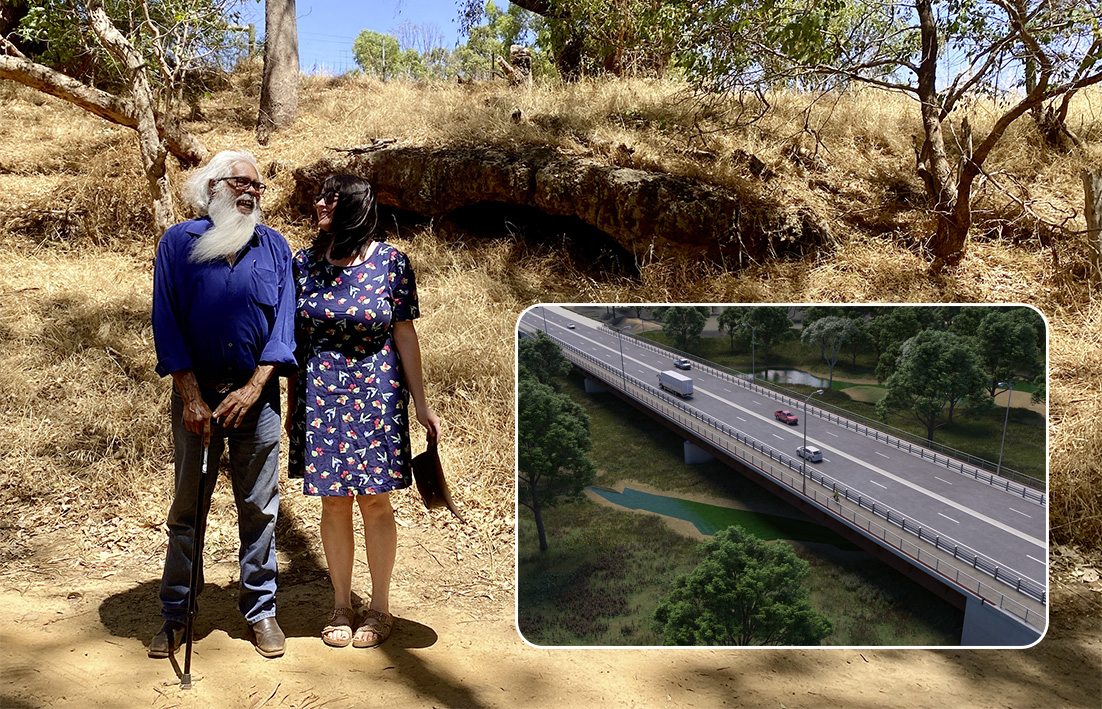
The new design features a 180m long bridge, spanning most of the Helena River floodplain, with two sets of supporting piers to be positioned away from culturally sensitive areas.
According to the state government, the new design also significantly reduces the project’s footprint, reducing the vegetation clearing requirement by around 20 per cent.
The bridge is planned to have two lanes in each direction, as well as paths for pedestrians and cyclists.
With key design principles agreed, the project will proceed to the detailed design stage.
This will be accompanied by site investigations and broader stakeholder engagement.
Subject to detailed design progression, construction works could begin around the end of 2026.
The project will be broadened to include the connection of Lloyd Street to the intersection of Great Eastern Highway Bypass and Abernethy Road, completing long-planned Lloyd Street link between the Great Eastern Highway and the Bypass.
It will also support the growth of the Hazelmere industrial area and reduce congestion on local roads, including Stirling Crescent, Military Road and Clayton Street.
By connecting the Lloyd Street and the Great Eastern Highway Bypass, the project will enable future construction of the proposed Roe Highway and Great Eastern Highway Bypass Interchange.
The Lloyd Street Bridge project is being delivered by Main Roads on behalf of the City of Swan and is co-funded by the state and federal governments.
West Swan MLA and Minister for Transport Rita Saffioti said the collaboration between state government and Traditional Owners on the bridge design was of a major scale.
“Back in 2022, Traditional Owners and other local stakeholders raised significant concerns about the impact of the bridge design on Aboriginal heritage sites and the environment,” she said.
“This resulted in the submission of a Section 10 Application to the federal government under the Aboriginal and Torres Strait Islander Heritage Protection Act.”
Ms Saffioti said the option was there to continue building the previous design.
“Instead, our government, Main Roads and the City of Swan listened, worked with the Traditional Owners to get a better understanding of their concerns and set out to work towards a design the whole community could be proud of.
“The agreed design, which will be one of the longest multi-span bridges in the state, is a result of collaborative co-design, and we thank the Traditional Owners and their advisors, the Bibbul Ngarma Aboriginal Association (BNAA), for working with us to achieve a much better outcome.”
Midland MLA Steve Catania said the outcome was the result of a lot of work behind the scenes and thanked the Traditional Owners for sharing their stories and connections to the site.
Hasluck MP Tania Lawrence said the progression of the project was welcome news.
“The bridge will reduce congestion and bottlenecks on surrounding roads and make it easier for residents, workers and visitors to move around,” she said.
“Importantly, the project design has been shaped through collaboration with Traditional Owners, whose knowledge of the Helena River system has ensured improved connectivity does not come at the expense of protecting the Helena River and its banks.”
BNAA executive director Francesca Flynn acknowledged Noongar Senior Elder, Greg Ugle (RIP) who made the bridge redesign possible.
“Uncle (RIP) was instrumental in the Section 10 process, and it was through his strong leadership, determination and advocacy that we were able to work with the state government to redesign the bridge and better protect Noongar cultural heritage.”
Noongar Traditional Owner and son of Greg Ugle (RIP)Ben Ugle said for thousands of years, Noongar people had cared for our rivers through knowledge, respect and responsibility to Country.
“We support sustainable river protection.
“Protecting our river is not only about the environment, it is about preserving our living connection to Country and ensuring that our cultural responsibilities continue for the benefit of all Western Australians.”