A NEW study by researchers at Murdoch University has found that citizen science is crucial for the effective surveillance, detection, and monitoring of invasive pests.
The study, titled ‘Polyphagous Shot Hole Borer, a Global Threat to Forest Plantations, Green Infrastructure, and Biodiversity: Status, Challenges, and Solutions,’ argued that Western Australian officials were too slow to engage the public in Polyphagous Shot Hole Borer (PSHB) detection and that more efforts are needed to educate the public.
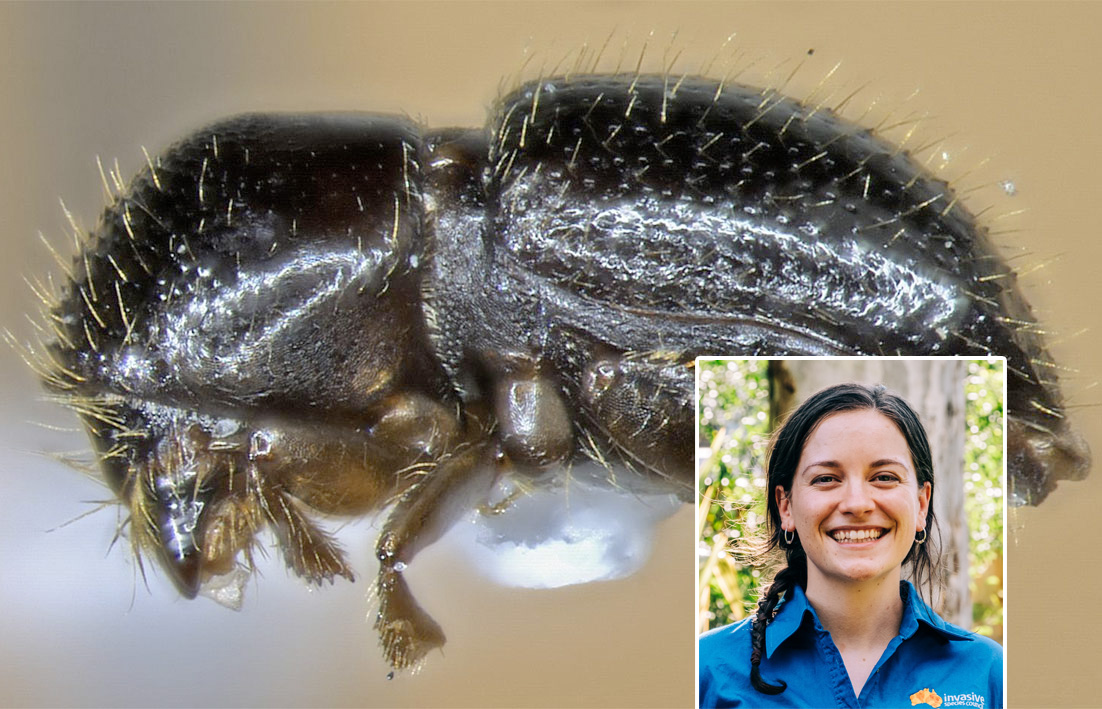
Invasive Species Council citizen science coordinator Jess Ward-Jones said the study brought to light to an important issue.
“One of the potential reasons that the infestation has become quite bad is that even though the beetle was detected in 2021, it took about three years for authorities to ask communities to engage with surveillance,” she said.
The Invasive Species Council, in partnership with Invertebrates Australia and Australian Geographic, has a project called Bug Hunt to encourage the community to get involved.
“What we’re asking people to do is record photos of bugs when you’re out and about or in your backyard and then upload them into a free app called iNaturalist,” Ms Ward-Jones said.
“It just takes seconds for an artificial intelligence algorithm to recognise what that bug is and then bug experts will come along to verify that record. It goes off to Atlas of Living Australia, which is a database managed by the Commonwealth Scientific and Industrial Research Organisation, the National Science Agency.”
As reported in LGAs on state budget funds and borer control (Echo News, June 12), City of Swan and Town of Bassendean are quarantine areas for the PSHB, which means moving untreated wood, green waste or host plants outside these zones is strictly restricted.
PSHB is also a present risk across the City of Kalamunda but has not been detected inside the Shire of Mundaring, York, Northam and Chittering – although the Shire of Mundaring sits within the quarantine zone.
Ms Ward-Jones said residents should know the signs of PSHB infestations.
“It can affect any tree, and symptoms include canopy dieback. Also down on the bark, PSHB bore into the wooden part of the tree and bring a little fungus with them. That fungus then eats the tree – symptoms of that include tiny little holes and then something called frass, which is like a very fine wood dust coming out of the tree, discoloration of the bark, and sometimes sugar or gum can come out of those little dots,” she said.
Ms Ward-Jones hopes to bring the public to the forefront of the battle against invasive species.
“Early intervention or early detection of invasive species is absolutely integral for reducing the impact and potentially completely eradicating invasive species. So what we hope is that we can get a million more eyes on the ground using this bug hunt to stop PSHB establishing in any new places,” she said.
People can report PSHB sightings through the MyPestGuide® Reporter app, call the Pest and Disease Information Service (PaDIS) at (08) 9368 3080, or email padis@dpird.wa.gov.au