THE WA Horse Council is calling for clearer rescue responsibilities, specialist equipment and more training after an Ellenbrook horse float rollover.
WA Horse Council chair and equine veterinarian Kathy Klein said the May incident showed that a prompt emergency services response needed to be backed by people trained and equipped to extract horses safely.
“The horse float rollover in Ellenbrook in May exposed a serious gap in the state’s large animal rescue capability,” she said.
“Department of Fire and Emergency Services (DFES) responded promptly, with a fire appliance arriving quickly from just a block away.
“However, despite emergency services being on scene, control of the rescue and decisions about how to extract the trapped horse were effectively left to experienced equine industry personnel and the attending veterinarian.
“The veterinarian was placed in considerable danger while attempting to assist the trapped horse, without appropriate personal protective equipment, including a helmet.
“The issue was not the speed of the emergency services response, but ... absence of established large animal rescue procedures, trained personnel, appropriate equipment and effective scene management.”
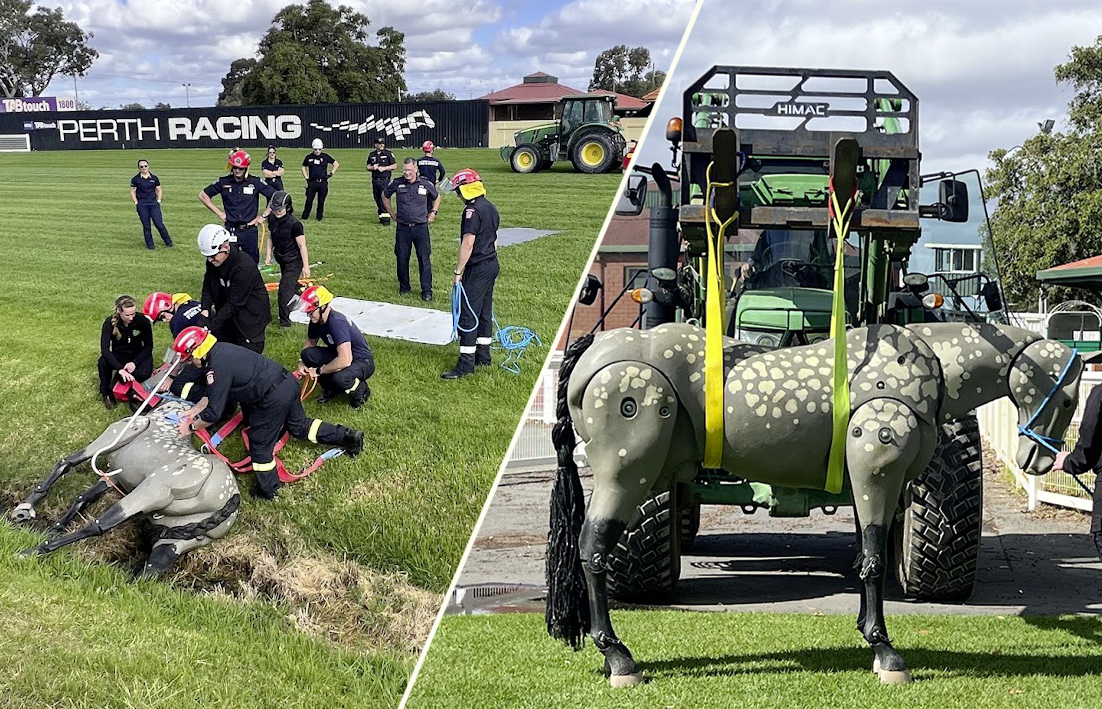
The call follows three days of large animal rescue workshops at Ascot Racecourse from September 30 to October 2, bringing together emergency responders, local government staff, veterinarians, animal welfare organisations and the equestrian and racing industries.
The City of Swan reported in August last year that its rangers rescued a ewe from a steep riverbank at Herne Hill after a resident raised the alarm.
The ewe and her surviving lamb were reunited and returned to their owners.
Workshop reports supplied by the horse council also acknowledged Swan councillor Rod Henderson’s ongoing support.
Dr Klein said the Ellenbrook rollover exposed uncertainty over who was responsible for physically undertaking a large animal rescue and protecting those helping at the scene.
“We need to know not simply who responds to the emergency, but who is actually trained and equipped to perform the rescue,” she said.
She said DFES responded promptly, but decisions about extracting the trapped horse were effectively left to experienced equine industry personnel and the attending veterinarian.
Dr Klein said communities needed more than an emergency services response.
“We need the training, equipment and established procedures to ensure that large animal rescues can actually be performed safely,” she said.
She said similar challenges arose when horses or livestock became trapped in dams, drains, mud, swimming pools or confined spaces.
The horse council wants domestic animal rescue more clearly recognised in the state’s emergency management legislation and operational arrangements, particularly for individual incidents outside major emergencies.
Its priorities include defined rescue responsibilities, equipment located strategically across metropolitan and regional WA, training for likely responders and established procedures for accessing specialist people and resources.
Dr Klein also called for greater cooperation between emergency services, veterinary professionals, animal welfare organisations and the equine and livestock industries.
“We don’t need to reinvent emergency management. We need to ensure that rescuing domestic animals, including horses and livestock, is recognised and supported within the systems we already have,” she said.
WA’s animal welfare in emergencies state support plan assigns animal welfare coordination to the Department of Primary Industries and Regional Development.
It provides for activation when owners’ capacity and local or district arrangements are insufficient, and also allows departmental advice and connections before activation.
Dr Klein said animal welfare coordination and the practical ability to rescue a trapped large animal were distinct needs.
The Ascot workshops were presented by the horse council with the Animal Emergency Incident Management Network, with David King leading the training.
The first day focused on emergency services and animal welfare responders, followed by equestrian sport and then racing personnel and veterinarians.
Training emphasised scene safety, communication, teamwork and techniques for moving or lifting a compromised horse. The racing programme also addressed starting barrier incidents and other racecourse emergencies.
Dr Klein said the workshops had generated interest in further training and simulation exercises, including from Murdoch University and emergency services personnel.
She said the council had supported rescue training and advocacy for more than a decade, with its first Ascot workshop held in 2012.
“However, interest and goodwill must now translate into practical commitments to training, equipment and operational capability,” she said.
“Animal welfare and human safety go hand in hand. We owe it to our emergency responders, our communities and the animals themselves to get this right.”