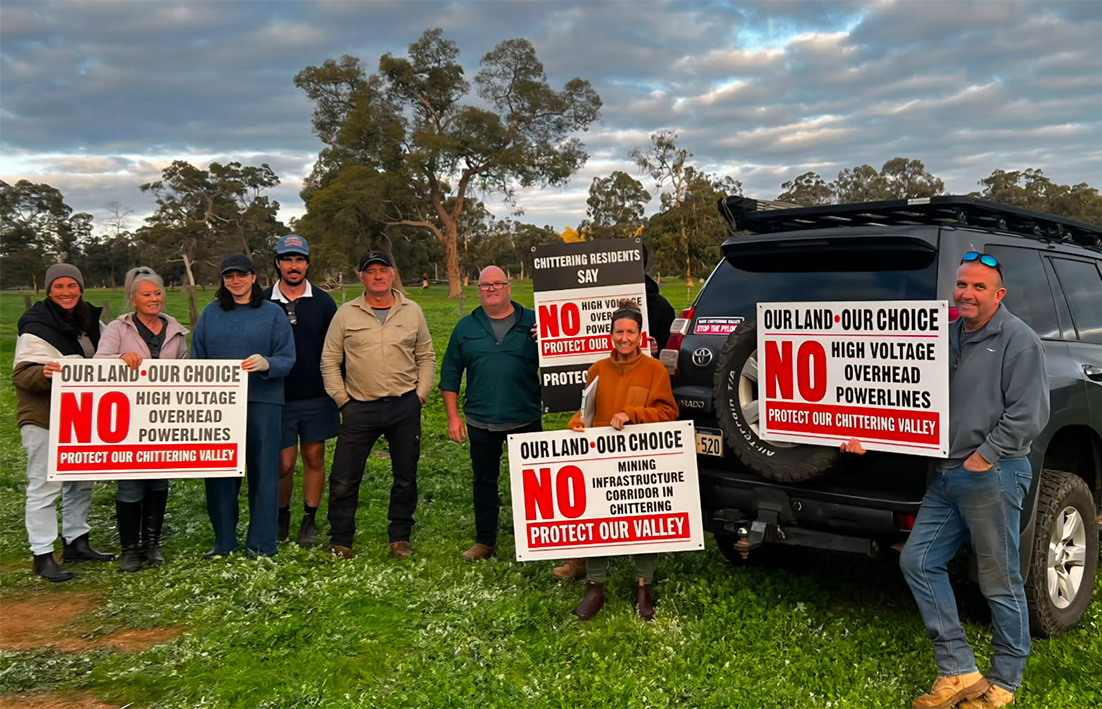
CHITTERING residents have called on council to advocate for ratepayers’ concerns regarding Chalice Mining’s Gonneville project infrastructure.
During question time at last week’s council meeting, residents said they felt that the shire wasn’t doing enough to advocate on behalf of ratepayers, and asked council to clarify its role.
As reported in Infrastructure corridor concern in Chittering, on June 17 council passed a motion to advocate against mining infrastructure through private properties and for existing or underground infrastructure to be used as preference.
Lower Chittering resident Atika Poole said council should look at its own history and other local councils as an example.
Ms Poole cited the council’s refusal of a bauxite mine within the shire in 2009 and the Shire of Mundaring’s advocacy against Alcoa in 2025.
“We hope this council will be remembered for its leadership, like those in 2009 and 2025, as a council that understood what was at stake, had the courage to take a stand and put the long-term interests of their community ahead of the commercial interests of a mine,” she said.
“Does the shire support the Gonneville mine and its associated infrastructure through our valley? If not, will it advocate for the protection of Chittering’s established identity, environment and the future our community has spent generations planning for?”
Shire of Chittering President David Dewar said council will remain impartial on the Gonneville project, as the mine itself is outside the shire’s boundaries, but that it will still advocate on behalf of residents.
A Chittering Rise resident asked if Gonneville project infrastructure was in accordance with the shire’s local biodiversity strategy.
“The strategy mentions that the greatest threat in the shire is subdivisional development or other types of development that require clearing of native vegetation,” they said.
“Has the shire assessed the proposed Gonneville infrastructure corridor against its own… strategy, including the potential fragmentation of habitat relied upon by local fauna, and has that information been provided to state authorities assessing the proposal?”
Cr Dewar said the shire had not assessed the infrastructure corridor in relation to its biodiversity strategy, but that it had raised tree preservation areas, wildlife habitat, vegetation, drainage and cumulative impacts with the relevant state ministers.
Wisteria Way resident Sonia Cook raised concerns regarding access to public information.
“Much of the work of identifying and communicating developments about the Gonneville project to residents has fallen to unpaid community volunteers,” she said.
“As regular public reporting does not require council to support or endorse the project, will council commit to regular public reporting so ratepayers can see what action is being taken, what responses are being received and how this project is progressing?”
Cr Dewar said significant developments would be reported when reliable information, a submission, an advocacy position or council direction is required.
Residents also raised concerns about pollution affecting drinking water and water catchments, increased traffic affecting emergency responses, impacts on the rural character of the Chittering Valley and potential destruction of Carnaby’s black cockatoo habitat.
Council said these were matters for state assessment processes and that separate shire-funded assessments could duplicate those processes and create a significant unbudgeted cost for ratepayers.
A Protect Our Valley Chittering spokesperson said the community felt disappointed with the council’s responses.
“We understand that the shire is not the authority responsible for approving the mine, but... the shire has a stronger institutional voice than individual residents,” they said.
“It should be using that voice strongly and consistently while the project is still being assessed and while alternatives can still be considered.
“Residents should not have to repeatedly use public question time simply to establish what information council has received, what discussions are occurring and what advocacy is being undertaken on their behalf.
“For some residents this is intensely personal. Proposed infrastructure could run straight through or alongside their properties. Others could potentially experience increased heavy traffic or other impacts. These are people’s homes and communities, not simply lines on a project map.”
Mid-West MLA Shane Love, whose electorate includes Chittering, also weighed in on the concerns, saying he recently met with concerned residents and the council.
“I have also met with Chalice Mining to discuss the proposal directly and to better understand the company’s plans. I have a further meeting scheduled in October and will continue to engage with all parties as more information becomes available,” he said.
“My focus is ensuring that local residents have the opportunity to have their concerns properly considered and that any decisions are made transparently, with a clear understanding of the impacts on the community.”
According to Chalice, the proposed infrastructure corridors remain under assessment, with route options and mitigation measures under active investigation and consultation.
The Environmental Protection Authority is assessing the adequacy of Chalice’s environmental review document before it is released for public comment, which is now expected to happen late 2026.