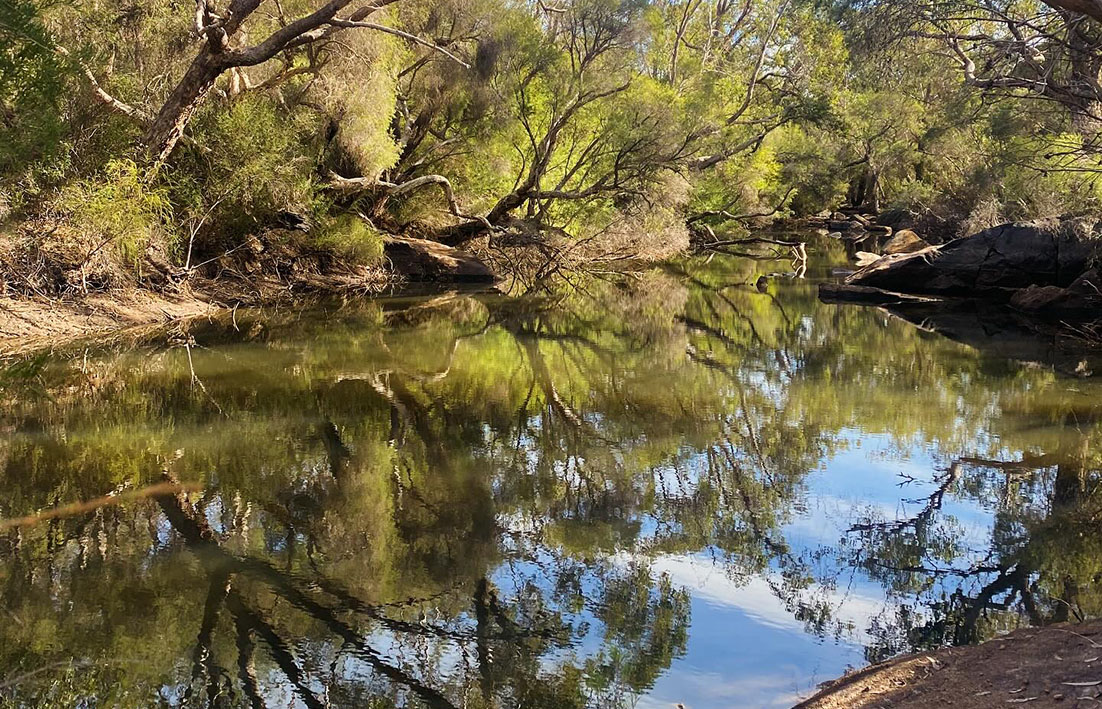
THE deteriorating state of the Mandoon Bilya (Helena River) is motivating organisations like the Bibbul Ngarma Aboriginal Association (BNAA) to start work on improving the river’s health.
BNAA executive director Francesca Flynn said the charity recently published a report based on samples collected in September last year.
“The sampling was undertaken as part of BNAA’s BoorYul-Bah-Bilya program (BBB),” she said.
“BBB is a recent and groundbreaking initiative we have developed to address declining river health by creating a new type of community catchment plan that is modelled on the Helena River but can be applied to any river.
“The sampling was undertaken to help us understand the current health of the river and contribute towards a baseline for further investigation and monitoring future changes in the river’s health.”
During the sampling, Ms Flynn said the team didn’t have a suitable vehicle to support their work along the river.
“Our volunteers had to carry lots of heavy sampling equipment to some of the more difficult to reach locations.”
However, with the support of Bendigo Community Bank Mundaring, Ms Flynn said that wouldn’t be the case for future sampling events with a recently funded four-wheel drive vehicle for the BBB program.
She said 12 locations across the catchment were sampled, which was the most samples collected from the river in a single sampling event in the last 20 years.
“Laboratory analysis is not cheap, so 12 was the maximum number of locations we could afford to sample, but we would have sampled more if we had more budget.
“The sampling locations were carefully chosen to give us maximum coverage across the catchment, and to target current and historical land uses that impact the river’s health or how the community interact with the river.”
Ms Flynn said land clearing, water abstraction, pollution, erosion, feral species, pests and increased bushfire risk all contributed to the pressure placed on the river.
“There is a general lack of awareness and understanding about the value of the river compared to other Perth rivers, including a common misconception that it is not a “real” river because it has lost much of its water flow.”
One of the key findings from the report was a general decline in water quality in the lower catchment.
Ms Flynn said there were many reasons behind the decline in the water quality.
“Low water flows due to the damming of Mundaring Weir and the Lower Pumpback Dam result in poor water quality, low oxygen levels and sedimentation, as well as disconnection of pools, loss of habitat, barriers to fish movement and limited gene flow.
“Since colonisation, the lower river has had a history of neglect and a legacy of industrial contaminative land use including the former Midland Railway Workshops, the OPEX oil refinery, brickworks, a tannery and an abattoir.”
She said the results would be used to inform the BBB conservation audit.
“The sampling results will be combined with findings of other work we are undertaking.”
Ms Flynn said more research was needed to further understand the spatio-temporal trends and associated potential risks to users and freshwater ecosystems.
To learn more about the results visit https://bibbul.org/wp-content/uploads/2025/04/2025-BNAA-BBB-LHAAC-Mandoon-Final-Sampling-Report.pdf