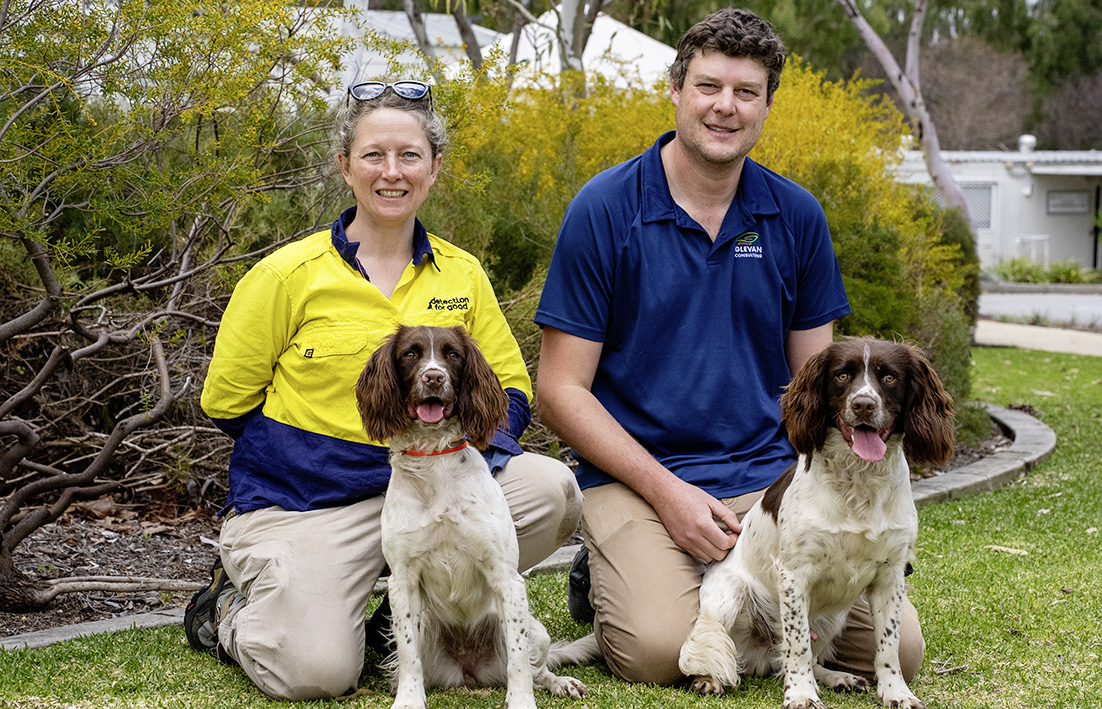
TWO new scent detection dogs have been delivered to Western Australia and partnered with their new handlers as part of a multi-state Saving Native Species project.
Milo and Kelly are both English springer spaniels and will be used by the Department of Biodiversity, Conservation and Attractions’ (DBCA) Plant Diseases Program to sniff out Phytophthora dieback on the conservation estate.
The dogs have been trained to detect the microscopic plant pathogen that causes Phytophthora dieback, Phytophthora cinnamomic, the greatest disease threat to the flora of the south-west bioregion of WA, where it is known as the ‘biological bulldozer’.
Following successful pilot studies by TATE Animals and New South Wales National Parks and Wildlife Service, DBCA secured $1.3 million in grant funding from the Australian Government’s Saving Native Species Program to train and deploy dogs across the country.
The project included TATE Animals training two new dogs in New South Wales, for deployment to WA.
The dogs have now been delivered to their handlers and Milo has been partnered with Liam Brown of Glevan Consulting, which provides dieback mapping services, while Kelly has been partnered with Megan Barnes of Detection for Good, which deploys detection dog teams for environmental and health applications.
DBCA is the lead agency for the dieback detector dog project in which teams of dogs and handlers will be used to help manage threats to native plants in three States - WA, NSW and Tasmania.
Environment Minister Matthew Swinbourn said it was fantastic that WA was leading the way in the tri-State initiative to protect threatened species and biodiversity from the scourge of dieback.
“These energetic and friendly dogs have the capacity to deliver cost-effective rapid detection of Phytophthora cinnamomi in both the lab and the field.
“By using dogs this way we aim to change the way dieback is mapped by land managers, which has follow-on benefits not only for conservation but also for farming, forestry and industry.”
Federal Minister for the Environment and Water Murray Watt said Phytophthora dieback was one of the greatest plant disease threats to Australia’s natural environment.
“It spreads easily in infested dirt or mud carried in vehicles, boots and equipment so detector dogs are a game-changer in protecting threatened species.
“By identifying disease free sites, they help safeguard threatened plants like Foote’s Grevillea - one of 30 priority species in the Albanese government’s Threatened Species Action Plan.
“The Albanese Government is proud to support the hard work of Milo, Kelly and their handlers through our Saving Native Species Program.”
For more information visit the DBCA dieback webpage.