THE importance of slowing down, finding purpose and helping others flourish was at the centre of the October Hour of Power.
Speakers challenged attendees to reconsider their relationship with productivity and success.
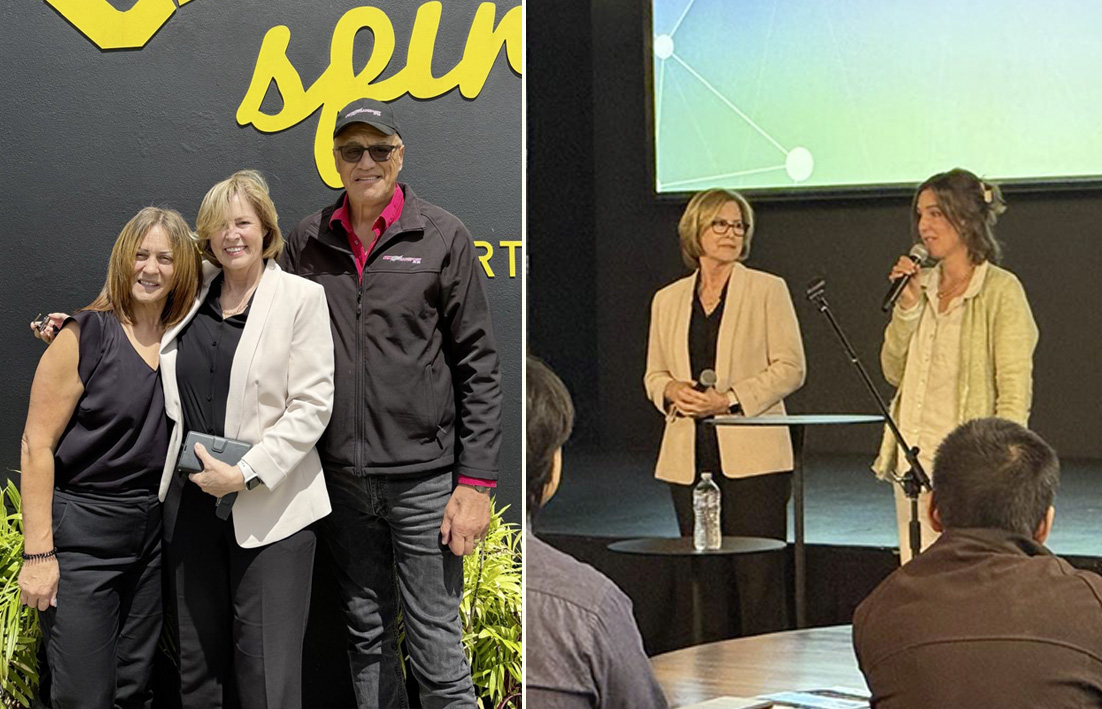
Press Road Media brand and media strategist Anjelica Smilovitis opened her presentation by inviting the audience to sit in complete silence for one minute, without phones, conversation or distractions.
She then recalled visiting her family doctor about 12 years ago, when she was 27, after experiencing a period of emotional numbness.
At the time she was working as a personal trainer while studying psychological science and regularly started work at 4am, filling her days with clients, study and other commitments.
Ms Smilovitis said she found herself feeling increasingly disconnected despite being passionate about her work.
“I didn’t feel joy, I didn’t feel sadness,” she said.
“I just felt completely (stuck)… which felt weird to me because I was someone that was quite passionate about life and I was motivated (and) I loved what I did.”
When her doctor asked how much time she spent relaxing, she found it hard to answer.
He recommended taking an hour each day to unwind, prompting her to begin with a compromise of 20 minutes sitting outside doing absolutely nothing.
However, the experience initially proved uncomfortable as her inner monologue discouraged her.
“You’re lazy. Get up and keep going. You’ve got a list of things to do,” Ms Smilovitis said.
“What if someone sees you over the fence and sees you just sitting there doing nothing?”
Ms Smilovitis said her stubbornness helped her persist until she gradually began appreciating the stillness.
Hiking was eventually incorporated into her routine as she continued her practice of stillness.
While walking, she discovered that creative ideas for her writing came more naturally than when she was sitting at a computer trying to force them.
The practice also helped her return to work and personal relationships feeling refreshed and more present.
Ms Smilovitis recalled how childhood boredom had encouraged her and her siblings to invent games and explore their surroundings.
“What was amazing is that we would go out there, my brother, my sister and I, and we’d create new games, just out of thin air,” she said.
“We’d get everyone involved and we had created something completely new.
“Somewhere in that boredom, creativity happened, problem-solving, imagination and curiosity happened.”
Ms Smilovitis said modern society’s constant access to social media, artificial intelligence and other distractions had potentially diminished people’s capacity for creativity.
“The moment we feel bored or uncertain or stuck, we reach for our phones, we look for distractions, we fill our time under the guise of productivity,” she said.
“But what if that space is an opportunity?
“I just wanted to leave you with a question: what if over time our busyness and stress have woven themselves into our lives to the point that it’s become normalised?
“What if leisure, rest, or stillness has become something to be feared rather than enjoyed or pursued?”
Swan Christian Education Association executive principal Dr Darnelle Pretorius followed with a presentation about leadership, personal values and helping others reach their potential.
Drawing on her experience in education, in which she holds an educational doctorate, she discussed the importance of understanding one’s purpose and aligning personal behaviour with professional responsibilities.
Dr Pretorius said she found wisdom in Stephen Covey’s The 7 Habits of Highly Effective People, pointing to its principles of seeking to understand others before expecting to be understood and finding solutions that benefitted everyone involved.
“(Ask yourself) how can I come out of a difficult situation so that both of us walk out smiling?” she said.
“Think win-win.
“I wanted to be a highly effective person… (Covey) talks about, firstly, having a private victory in your life before you step into the public arena.”
Dr Pretorius said probing one’s own spirit, private thoughts and analysing how things were organised in private was reflected in the energy that was put out in public.
“Your public persona reflects what’s inside,” she said.
“I think as we equip ourselves and we walk into our workplaces every day and we come with joy, we will become infectious.
“People that are generous attract generous things in their lives and people who are kind attract kindness.”
Dr Pretorius said leaders should empower others rather than micromanage them, while creating environments where people feel encouraged to succeed.
“Seek first to understand and allow that person to talk you through their thinking,” she said.
“Clarity is kind.”
Both speakers discussed the role of Christian faith in their lives, describing prayer and quiet reflection as important daily practices that helped them find stillness and consistency.
Echo News asked both speakers about the importance of maintaining boundaries while remaining generous.
“We can only really be responsible for what we’re in control of and so if a person is behaving badly or taking advantage, you can’t allow that and obviously you’ll walk away from it,” Dr Pretorius said.
“So, when I feel like a person is taking advantage, I’m not in control of that and I would then step away and allow them to take their own decisions.”
Ms Smilovitis said the answer was unique to each person but returning to the practice of stillness helped her identify her own boundaries.
“That stillness helped create confidence and trust within myself which I think is very important,” she said.
“For me, my anxiety was, ‘If I don’t do this, I’m going to lose my job or I’m going to lose this opportunity,’ and in some cases that is the case because that’s the system you’re in.
“But in the stillness, you can be honest with yourself and say, ‘I can’t keep going on that rat mill’.
“It’s what drove me to start my own business because I wanted to create my own space with those healthy boundaries in place.
“Sometimes just exploring ‘Why is it that we perhaps feel we need to over-give or maybe we can’t speak up or have a boundary?’ is what we need.”