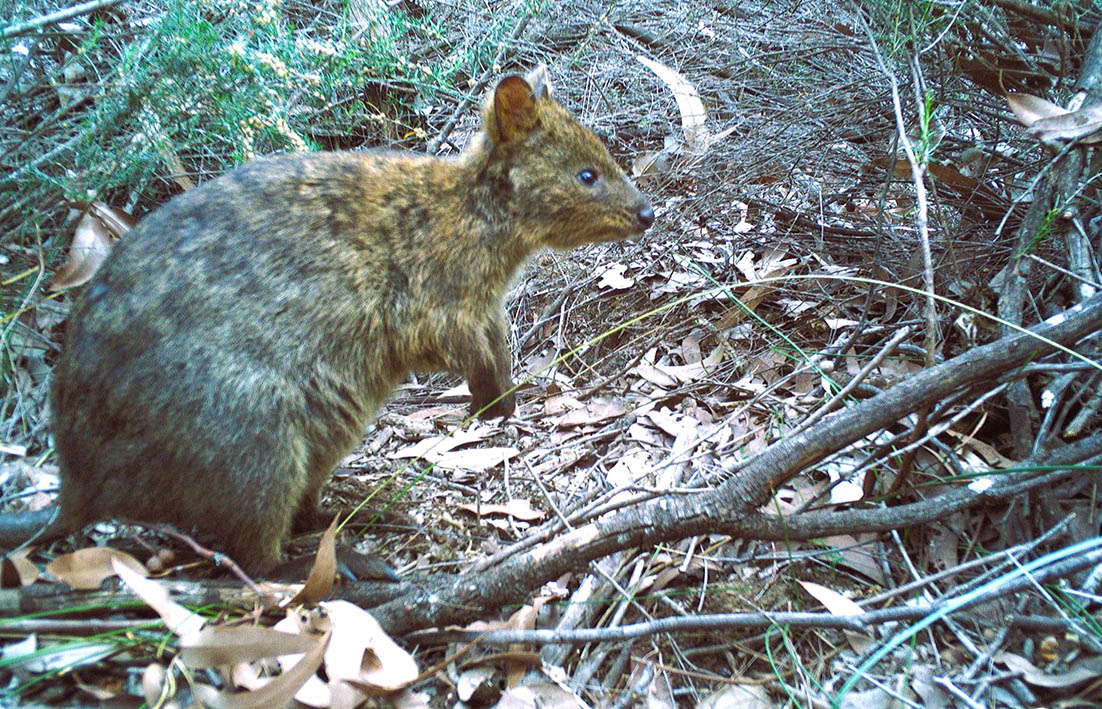
EFFORTS to better understand and protect a rare mainland quokka population in the Perth Hills have expanded as conservationists increase monitoring across the region.
Mundaring’s Bibbul Ngarma Aboriginal Association (BNAA) is continuing to track the Perth Hills quokkas through a growing network of fauna cameras as part of its BoorYul-Bah-Bilya (BBB) program.
The work builds on the earlier discovery of quokkas in the Perth Hills, with the program now focused on understanding their behaviour, population dynamics and response to environmental pressures in the Mandoon Bilya (Helena River) catchment.
BNAA executive director and environmental scientist Francesca Flynn said the monitoring had become one of the organisation’s most exciting citizen science initiatives.
“It is an absolute joy to be monitoring the Perth Hills quokkas and learning as much as we can about these incredible creatures,” she said.
“Their survival in the forests outside of Perth, despite the many challenges they face, is truly extraordinary.”
Quokkas were once widespread across south-west WA but have declined significantly since the early 20th century due to land clearing, fire and introduced predators such as foxes and cats.
Today, mainland populations remain fragmented and are rarely seen by the wider community, with most people still associating the species with Wadjemup-Rottnest Island.
Through the BBB program, BNAA is using a network of 10 monitoring cameras to capture data, with recent funding from Bendigo Community Bank Mundaring allowing the program to expand into new areas.
Ms Flynn said the additional monitoring would help inform future conservation efforts.
“It’s really exciting to be able to expand our monitoring program thanks to a grant from Community Bank Mundaring,” she said.
“We hope our work enables stronger protection for mainland quokkas and other threatened native species facing constant pressures from land clearing, fire, feral predators and a changing climate.”
BNAA chairperson and Noongar Traditional Owner Walter McGuire said the program also reflected the importance of community-led conservation grounded in cultural knowledge.
“The Noongar people, my people, have lived on this land for millennia,” he said.
“It is our role and responsibility to care for this environment, including the Mandoon Bilya and these little quokkas, as the First People of this land.”
BNAA is working with the Department of Biodiversity, Conservation and Attractions to support ongoing research and management, with the data expected to contribute to broader recovery efforts for the threatened species.
The organisation is also encouraging community involvement through citizen science, including biodiversity surveys and the use of platforms such as iNaturalist to record wildlife observations.