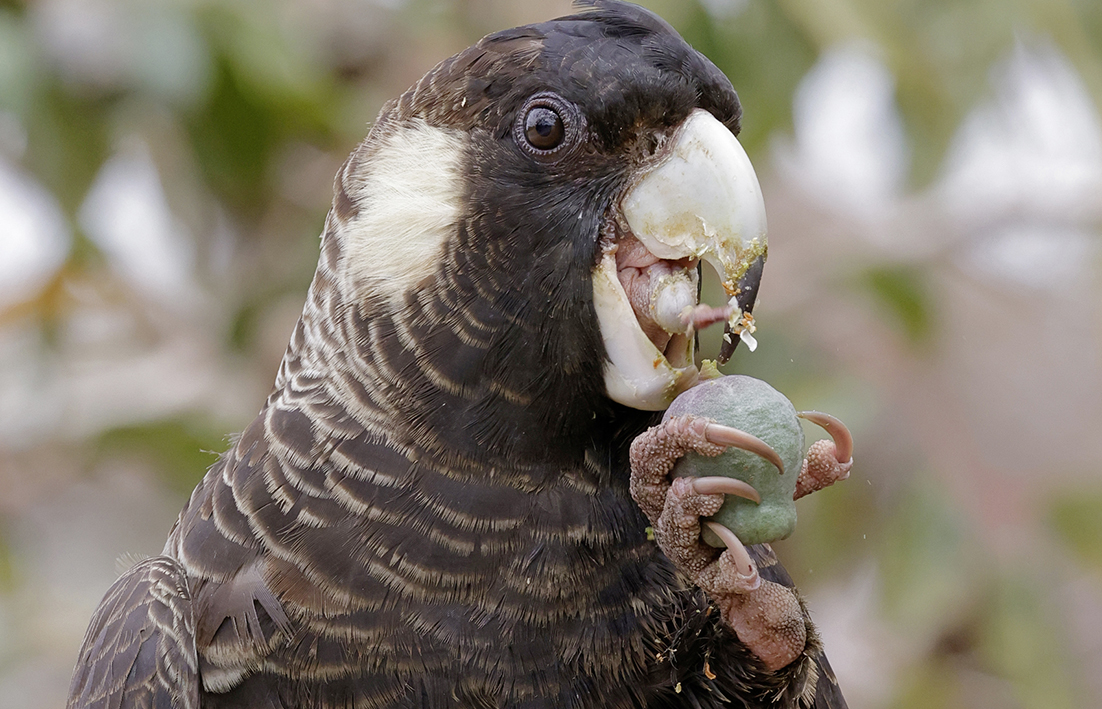
BIRDLIFE Western Australia has joined the opposition to Alcoa’s proposal to expand its bauxite mining in the Northern jarrah forrest and warns that Baudin’s black cockatoo will go extinct if the expansion goes ahead.
“Right now, US-mining giant Alcoa has applied to bulldoze over 11,000ha of forest on the Darling Scarp – equivalent to 6500 football ovals – critical black cockatoo habitat. A further 16,400ha of forest will be impacted,” Birdlife WA spokesperson Dr Mark Henryon.
The forests are home to WA’s iconic Baudin’s black-cockatoo – internationally recognised by the International Union for Conservation of Nature (IUCN) as critically endangered – as well as two other threatened species of Black cockatoos: Carnaby’s and the forest red-tails.
“Baudin’s black-cockatoo depend on the Northern jarrah forest for survival. They breed down south before migrating north to feed in the Northern jarrah forest during the non-breeding season,” Dr Henryon said.
“If we lose these forests, we lose the birds. Forever,” he said.
“Alcoa says its mine expansion will be safe for these birds, but their claims don’t add up.”
Dr Henryon said while Alcoa says it avoids high conservation value areas, its own documents show they will remove mature jarrah and marri forests that provide essential feeding grounds, roosting sites, and nesting hollows for black-cockatoos.
“Bulldozing these forests removes their homes and any chance of a future. Chicks perish. Parents starve.”
He said Alcoa claims it is restoring plant diversity and 75 per cent of mined areas are under rehabilitation.
“But research by experts at Curtin University showed that jarrah forests can never be restored after bauxite mining because bauxite itself is part of the forest’s ecological fabric,” Dr Henryon said.
“Not a single hectare of the 28,000 mined by Alcoa since the 1960s has met the WA Government’s own rehabilitation standards – a fact that has proven disastrous for all three of WA’s black-cockatoos.
“Alcoa claims that most animals return to rehabilitated areas, but this doesn’t apply to WA’s Black-cockatoos, they rely on old trees for food and nesting – trees that are destroyed during mining.”
He said Baudin’s black-cockatoo has already declined by more than 90 per cent in the last 40 years. Only 2500-4000 mature individuals remain.
WA’s Environmental Protection Act requires environmental offsets to counterbalance the lasting damage caused by a project and deliver measurable conservation benefits.
“But for black-cockatoos, offsets have repeatedly failed,” he said.
“Alcoa’s proposal is no different. It amounts to mapping and monitoring nesting trees, installing water troughs, raking around some tree bases to reduce the risk of fire, and conducting the occasional bird survey.
“It will not replace a single hectare of the 11,000 hectares Alcoa plans to destroy. It will not create new habitat. It will not halt, let alone reverse, the decline of Baudin’s.”
Dr Henryon claimed the WA Environment Minister, Matthew Swinbourn already knows it.
“Recently, the minister rejected a proposal to clear just 2.3 hectares of Carnaby’s Black-cockatoo habitat at Cocanarup, near Ravensthorpe, ruling that the “significance of the area and the scale of the impact … is unable to be adequately offset,” he said.
The Northern Jarrah Forest lies within the Southwest Australia biodiversity hotspot – one of only 36 recognised global hotspots for exceptional endemism and critical threat.
Dr Henryon said aluminium is the most abundant metal in the Earth’s crust.
“Is it really worth destroying a globally significant forest, pushing Baudin’s to extinction, and erasing WA’s invaluable natural heritage for this?”
As reported in Alcoa’s Perth Hills expansion zone Environmental Protection Authority released a survey which closed August 21 for residents to provide feedback on Alcoa’s proposal to expand operations into sections of the Perth Hills.